Imagine standing in a giant electronics factory, surrounded by thousands of tangled wires, each flickering with signals—yet nobody knows which wire does what. That is the internal world of a traditional large language model: a black box of superimposed computations. But a light has emerged from OpenAI's labs: they quietly open-sourced a tiny model with only 40 million parameters, with 99.9% of its weight connections pruned to zero, leaving just one-thousandth of active paths. The AI suddenly becomes as readable as a circuit board—we can trace every step of its logic and avoid being fooled by its 'nonsense.'
⚡ The Curse of the Black Box: Why Traditional AI Is a Tangled Mess
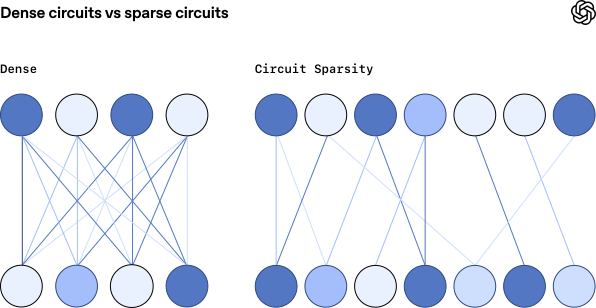
In a traditional Transformer, nearly every weight connection is non-zero, information floods through in a highly superimposed way. The AI can produce fluent answers, but when asked "why did you think that?" it can only shrug. The black box problem refers to the uninterpretability of a neural network's internal computation: features exist in superposition, where one neuron may handle multiple concepts at once, making decision paths impossible to trace precisely. This contributes to hallucinations and blocks deployment in safety-critical areas like medical diagnosis or autonomous driving.
OpenAI's team took the opposite approach: forcing the model to be "extremely sparse" from the start of training.
🔪 Cutting 99.9% of Connections: The Birth of Circuit Sparsity
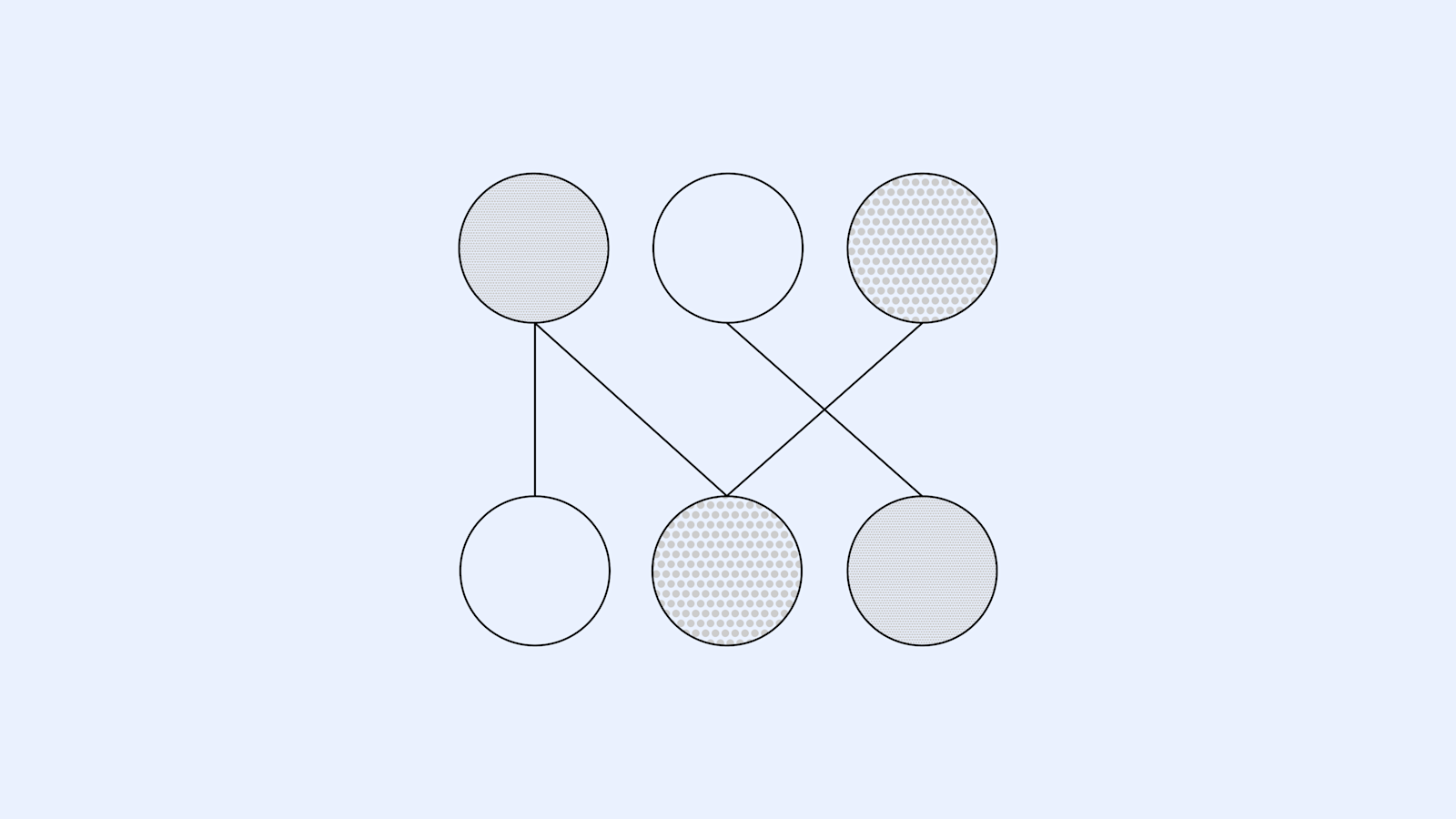
The open-sourced model is based on a GPT-2-style Transformer, but during training the L0 norm of the weights is strictly constrained, zeroing out 99.9% of weights. Only a fixed, sparse set of connections remains, like traces on a circuit board.
They also introduced mean masking pruning to decompose task-specific minimal circuits. For example, closing quotes in Python code requires only 2 MLP neurons and 1 attention head, forming a complete circuit with a quote detector, type classifier, and other modules—each doing its own job without interference.
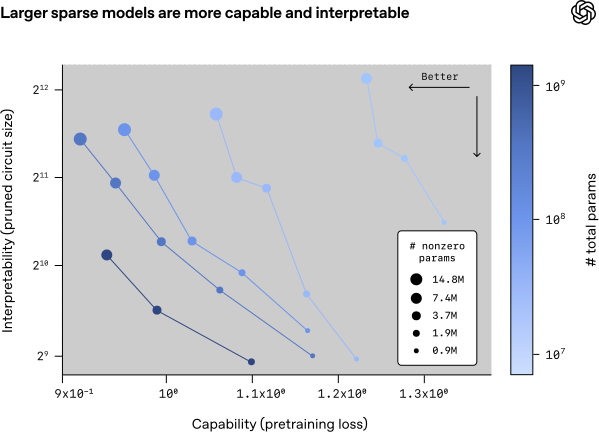
Remarkably, at equal pretraining loss, the sparse model's task-specific circuits are up to 16x smaller than those of dense models, with strict necessity and sufficiency: keep the circuit and the task succeeds perfectly; remove any node and it fails immediately.
This native sparsity makes features monosemantic and orthogonal: each concept activates only a few nodes in a very high-dimensional space, solving superposition at its root.
🆚 Versus MoE: Coarse Approximation vs Native Elegance
MoE (Mixture of Experts) simulates sparsity via a gating network that routes inputs to expert sub-networks—but this is a "coarse hack" designed to fit dense hardware computation. Expert boundaries blur, knowledge is redundant, and load balancing requires complex loss functions with unstable training dynamics.

Circuit Sparsity pursues native sparsity: features are orthogonal by design, no router required, with clean functional boundaries and precisely decomposable mechanisms. Some predict this "extreme sparsity + functional disentanglement" could eventually make MoE obsolete—though MoE remains the industry favorite for compute efficiency today.
💸 The Fatal Weakness: The Cost of Compute Hunger
There is no free lunch. Training and inference currently cost 100 to 1000x more than traditional dense models, and capability still lags top-tier large models. Two remedies are being explored:
1. Extract sparse circuits from existing dense models, reusing mature foundations instead of training from scratch—drastically cutting costs. 2. Train natively sparse models from scratch with improved training mechanisms, such as better activation sparsity or new algorithms balancing efficiency and interpretability.
🌟 More Complex Reasoning: From Quotes to Variable Binding
The team is also studying more complex circuits, like variable binding—tracking variable types and names in code. In sparse models, attention heads "write" information at variable definitions and "copy" it back at use sites. These circuits are larger and not fully decoded, but predictive structural descriptions are already possible. Scaling model size and sparsity improves capability and interpretability simultaneously—a promising "capability–interpretability frontier."
🚀 Outlook: A Long Journey to Lift the Black Box Veil
OpenAI stresses this is only an early step. Future plans include scaling to larger models, unlocking complex reasoning circuits, building a library of circuit patterns for investigating frontier models, and developing tools to analyze, debug, and evaluate future systems. When sparse circuits mature, the key to cracking the AI black box may turn out to be boldly cutting the redundant wires—letting truth shine through simplicity.
---
#### References 1. OpenAI. Understanding neural networks through sparse circuits. https://openai.com/index/understanding-neural-networks-through-sparse-circuits/ 2. Gao et al. Weight-sparse transformers have interpretable circuits. arXiv preprint, 2025. https://arxiv.org/abs/2511.13653 3. OpenAI GitHub Repository: circuit_sparsity. https://github.com/openai/circuit_sparsity 4. MarkTechPost Coverage on OpenAI Sparse Circuits Release. https://www.marktechpost.com/2025/12/13/openai-has-released-the-circuit-sparsity-a-set-of-open-tools-for-connecting-weight-sparse-models-and-dense-baselines-through-activation-bridges/