In the broad landscape of artificial intelligence, a new architecture is quietly emerging: mHC — Manifold-Constrained Hyper-Connections. The name sounds aloof, but its evolution reads like a layered adventure: starting from basic deep neural networks, hitting an information-transmission bottleneck, inventing residual connections, then pushing further into hyper-connections, and finally, guided by manifold theory, gaining a wise constraint that forms mHC. Let's walk through this lineage step by step in plain language.
Layer upon Layer: The Birth of Deep Neural Networks
Deep neural networks (DNNs) are the cornerstone of modern AI. The core idea is simple: stack many simple computational units (neurons) layer by layer, each transforming its input, until complex outputs emerge.
Mathematically, each layer computes:
\(y = f(x)\)
where \(x\) is the layer's input, \(f(\cdot)\) is the learned transformation (typically linear transforms plus nonlinear activations), and \(y\) is passed to the next layer.
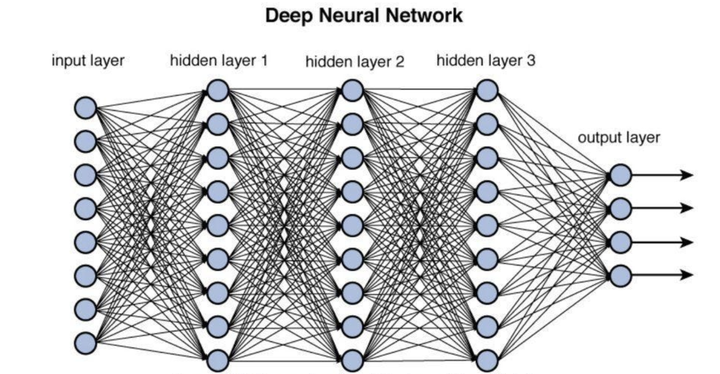
Stacking many layers can, in theory, fit extremely complex functions — that's why depth is powerful. But there's a cost: the deeper the network, the more information decays and distorts as it passes through layers. Vanishing gradients and training difficulty became persistent nightmares.
A relatable analogy: in a huge corporation, the CEO's strategy passes down through CTO → VP → Director → Team Lead → staff. With each layer, the message gets reinterpreted, and by the time it reaches the front line, the original intent may be unrecognizable. Early deep networks faced exactly this "information distortion" crisis.
Residual Connections: Building an Information Highway
To solve information decay, ResNet (2015) introduced the residual connection — a brilliantly simple change:
\(y = f(x) + x\)
The next layer receives not just the processed output \(f(x)\), but also the original input \(x\). This "shortcut" lets original information skip layers and flow directly downward.
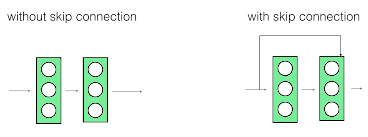
Back to the company analogy: the CTO now forwards the CEO's original words alongside their own interpretation; the VP forwards both, and so on down the chain. Employees can compare interpretations against the original intent, dramatically improving information fidelity. This small shortcut let networks scale to hundreds or thousands of layers, opening the golden age of deep learning.
Hyper-Connections: Breaking Hierarchies, Free Information Flow
Residual connections are still a "single-line shortcut" — only the input is added. Can information flow be richer?
Hyper-Connections (HC), proposed by the DeepSeek team, upgrade residuals aggressively: instead of simple addition, each layer can send weighted connections to many subsequent layers, even skipping several layers entirely.
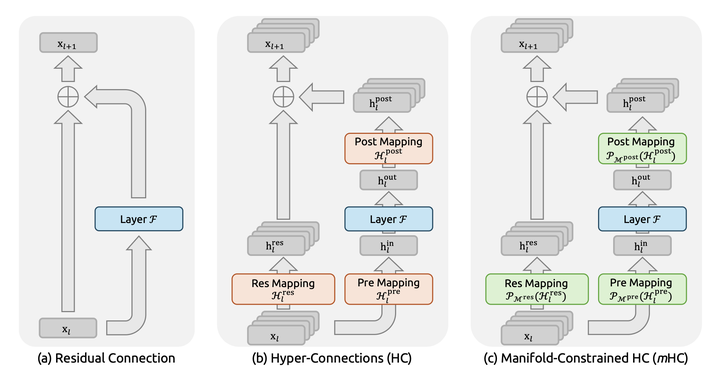
In the company analogy: besides forwarding originals, skip-level reporting is now allowed. The CEO can emphasize key strategies directly to Directors; the CTO can upweight technical directives and downweight financial ones. Information channels become diverse and flexible, and frontline staff receive the most relevant, amplified signals. In theory, such multi-path weighted connections propagate critical information far more thoroughly than traditional residuals.
The Mystery of Manifolds: Low-Dimensional Maps of High-Dimensional Worlds
To understand why mHC is necessary, we need the concept of a manifold. The most intuitive example: Earth's surface is a 2D curved surface on a 3D sphere, but a local city map can be treated as flat 2D with almost no information loss. This is "local Euclideanicity": low-dimensional up close, high-dimensional overall.
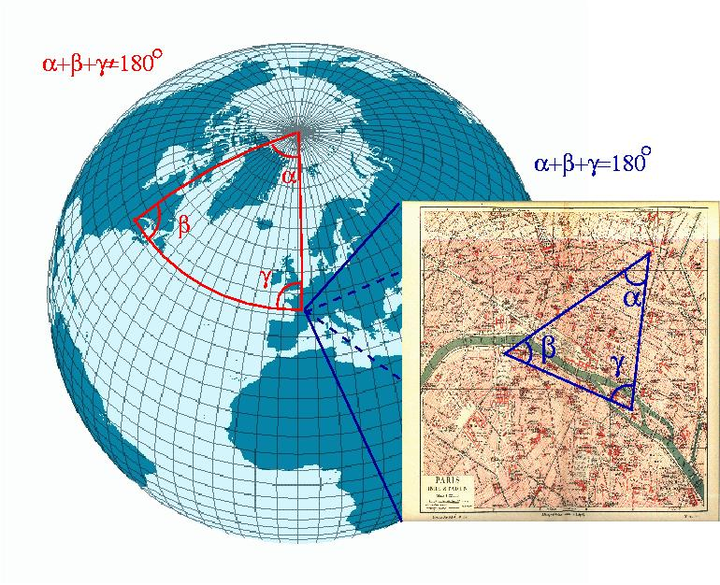
> A note on manifolds > In machine learning, we believe real data (images, text, speech), though embedded in very high-dimensional space, actually lies on a relatively low-dimensional manifold. The data's "intrinsic degrees of freedom" are far below its raw dimensionality — which is why dimensionality-reduction algorithms like PCA and t-SNE work.
Different layers learn representations at different abstraction levels — shallow layers capture edges and textures, deep layers capture semantics and concepts — so they may lie on different manifolds.
Manifold-Constrained Hyper-Connections: Balancing Freedom and Order
HC's free cross-layer flow brings new risks: forcibly injecting high-level abstractions into low layers can cause semantic mismatch and training instability.
mHC addresses this by adding manifold-matching constraints on top of hyper-connections: strong connections or high weights are only allowed when the sender's and receiver's representations lie on compatible manifolds (or can be projected into each other's comprehensible subspace).
Company analogy: the CEO's "improve product quality (fewer bugs)" can be emphasized directly to programmers, because it's expressed on a manifold they understand; but "expand financing, open new markets" is a different dimensional language for them — forcing it down only creates confusion. mHC acts like a smart secretary: deciding which directives suit direct skip-level delivery and which need translation or filtering, maintaining full information flow while avoiding oscillation from semantic mismatch. This "selective freedom" preserves HC's expressive power while keeping training stable.
The Sweater-Knitting Explanation (For Grandparents)
- Traditional deep network: knitting with a single strand — slow and prone to breaking.
- Residual connections: a spare thread — if one breaks, you keep knitting deeper.
- Hyper-Connections (HC): knitting with many strands at once — fast, with richer patterns.
- mHC: adding a smart thread untangler so multi-strand knitting doesn't tangle. The sweater is not only quicker to make, but sturdier, prettier, and less likely to unravel.
Closing Thoughts: A Naturally Evolving Lineage
From the information-decay problem of deep networks, to residual shortcuts, to hyper-connections' multi-channel flow, and finally manifold-theoretic constraints — DNN → Residuals → HC → mHC is a smooth, almost inevitable trajectory.
Notably, residual connections (ResNet), hyper-connections (DeepSeek team), and manifold-constrained hyper-connections all come from Chinese researchers, pushing the boundaries of model depth and expressiveness.
mHC is still at the paper stage; validation in open-source models is awaited. But the direction is clear: the future of AI lies not in merely stacking parameters, but in designing smarter information flow that respects the intrinsic geometry of data.
References
1. He K, Zhang X, Ren S, et al. Deep Residual Learning for Image Recognition[C]//CVPR 2016. (Pioneering residual connections) 2. DeepSeek Team. DeepSeek-V2 Technical Report[EB/OL]. 2024. (Core paper proposing Hyper-Connections and mHC) 3. Bengio Y, LeCun Y, Hinton G. Deep learning[J]. Nature, 2015, 521(7553): 436-444. (Deep learning survey) 4. Bronstein M M, Bruna J, LeCun Y, et al. Geometric deep learning: going beyond Euclidean data[J]. IEEE Signal Processing Magazine, 2017, 34(4): 18-42. (Geometric deep learning and manifolds) 5. Lee J M. Introduction to Smooth Manifolds[M]. Springer, 2012. (Classic manifold textbook)