Overview
TinyNav is a project from Queen's University students showing that end-to-end autonomous driving is possible on hardware costing about $20. Built around an ESP32-P4 microcontroller, it replaces heavy SLAM + GPU pipelines with a tiny convolutional neural network fed by time-of-flight depth data — an approach grounded in the principle of optical flow.
Why Optical Flow Matters
Human vision perceives the world not as static images but as a dynamic flow field: when you turn your head, nearby objects sweep past quickly while distant ones drift slowly. This relative motion carries depth information for free. A monitor displaying a static image fails this test — every pixel moves at the same speed when you shift perspective — whereas a mirror responds correctly. Optical flow (the motion vector field of pixels across frames) lets a robot infer relative velocity and depth without full 3D reconstruction: roadside trees that "flow" fast are close; distant mountains barely move.
Hardware
- MCU: Waveshare ESP32-P4-WIFI6-M — dual-core 360 MHz, 32 MB PSRAM, 768 KB cache (~$20)
- Camera: Sipeed MaixSense A010 time-of-flight (ToF) depth camera. ToF emits modulated infrared pulses and measures round-trip time per pixel, outputting distance directly. This avoids the 2D-to-3D ambiguity of RGB: a wall is not "a gray rectangle" but "an obstacle 1.2 m ahead."
- Raw 100x100 depth frames are 4x4-binned on-sensor to 25x25, then resized to 24x24 to fit the microcontroller's budget.
- steering: output in [-1, 1]
- throttle: output in [0, 1]
- Steering accuracy retained: 99.84%
- Throttle accuracy retained: 99.79%
- Inference latency (20-frame window + decision): ~30 ms — sufficient for real-time control
- Correlation: predicted steering/throttle vs. ground truth correlation of ~0.6 — solid for a 23k-parameter model; distributions show full-range decisions (no lazy zero-steering collapse).
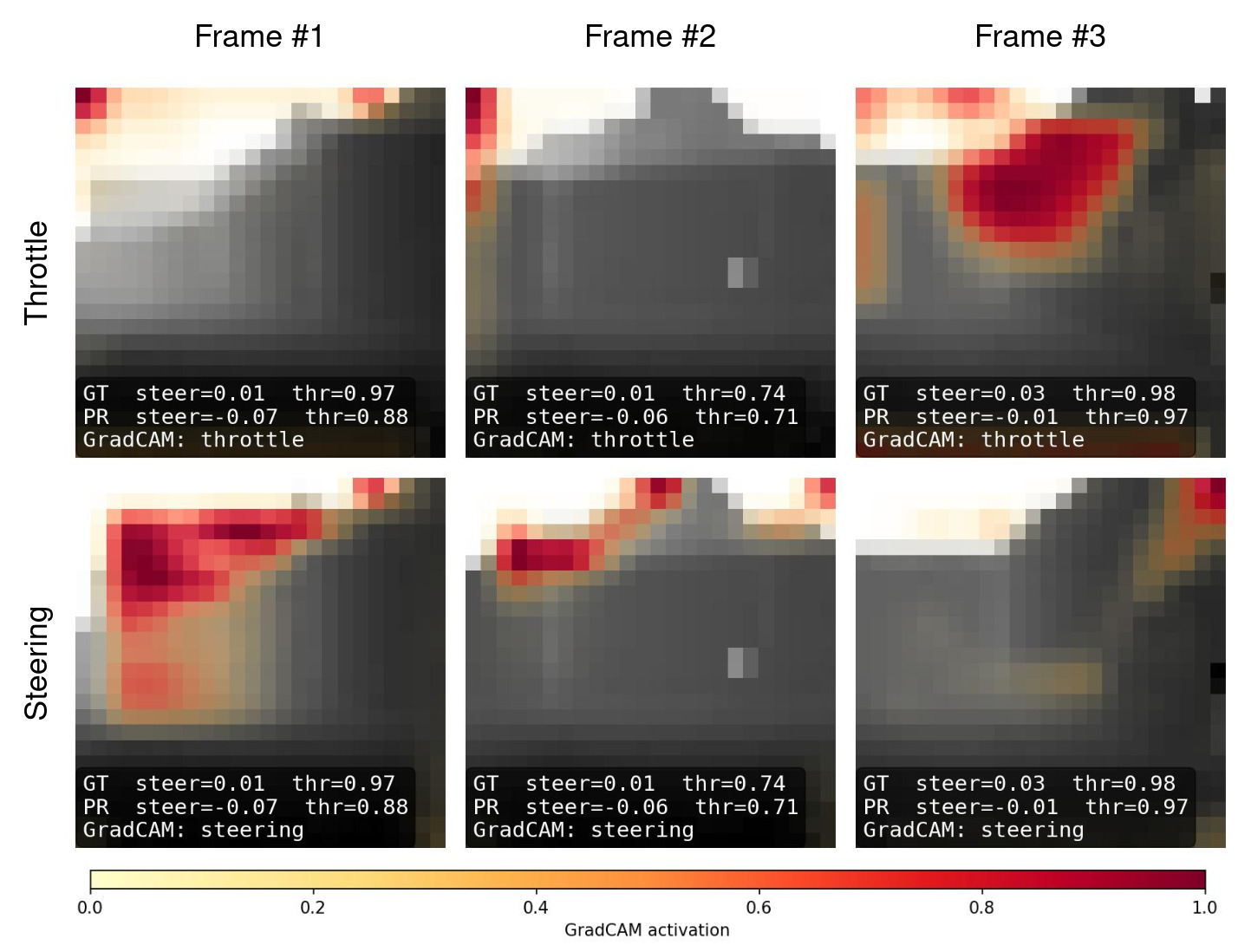
- Grad-CAM: the steering head attends to upper wall edges (most stable channel/obstacle discriminator); the throttle head looks at open space ahead on straights and fixes on approaching walls in dead ends, slowing appropriately.
- Field test: 40 consecutive collision-free laps on the training track; completed an unseen new layout with occasional light scrapes.
- ~50k parameter ceiling on the ESP32 caps model complexity
- Training data covers only an indoor track with low walls; no chairs, pedestrians, stairs, or outdoor lighting — weak generalization
- No wheel encoders/odometry, so pure vision drift accumulates error
- Forward driving only; reverse dynamics are untrained
Data Collection
Rather than simulation, the team built a physical track with movable wall panels (varying widths, curves, surfaces, dead ends) and teleoperated the car around it, recording depth maps paired with human steering and throttle commands. Data was augmented with horizontal flips and split 60/40 into train/test sets — an image-action dataset of real demonstrations.
Model: Temporal Stacking in a Tiny CNN
Navigation is continuous, but LSTMs and 3D convolutions are impractical on an ESP32. TinyNav's trick: stack 20 consecutive depth frames as 20 channels, forming a 24x24x20 spatiotemporal block that a standard 2D CNN can process — implicitly capturing motion and speed. The network is a few conv + pooling layers followed by two parallel fully connected heads:
Total: 23,000 parameters, end-to-end from raw sensor data to control commands, skipping explicit perception/mapping/planning modules.
INT8 Quantization
Post-training quantization via TensorFlow Lite Micro converts float weights to 8-bit integers:
Dual-Core Pipeline
One core runs CNN inference; the other handles sensor acquisition and motor commands, communicating through shared memory. A slow inference frame never blocks the control loop, keeping the car smooth.
Evaluation


Limitations & Future Work
The authors are candid about constraints:
Verdict
TinyNav is a compelling engineering exemplar for TinyML robotics: not algorithmically novel, but a complete, honest, highly reproducible closed loop (code and dataset open-sourced) that shows intelligence depends more on clever design than on big hardware. It is an excellent starting point for low-cost robotics in education, inspection, and smart home applications.
References
1. R. David et al., "Tensorflow lite micro: Embedded machine learning on tinyml systems," arXiv preprint arXiv:2010.08678, 2021. 2. Espressif Systems, "Esp-nn: Optimised neural network functions for espressif chipsets," GitHub repository, 2026. 3. A. G. Howard et al., "Mobilenets: Efficient convolutional neural networks for mobile vision applications," arXiv preprint arXiv:1704.04861, 2017. 4. M. Sandler et al., "Inverted residuals and linear bottlenecks," arXiv preprint arXiv:1801.04381, 2018. 5. R. R. Selvaraju et al., "Grad-cam: Visual explanations from deep networks via gradient-based localization," arXiv preprint arXiv:1610.02391, 2016.