Summary
This forum post on zhichai.net argues that large language models should not be micromanaged by engineers. The author's central claim, expressed in the title "Tear Down the Scaffolding — Large Models Don't Need to Be Micromanaged," is that developers often wrap foundation models in excessive layers of control, rigid prompts, and workflow scaffolding that constrain the model rather than leverage its capabilities. Instead of trying to steer every step of the model's reasoning and output, the author suggests treating large models as capable collaborators that perform better when given higher-level goals and room to operate. The post is presented on the Chinese tech forum alongside an SVG illustration hosted on IPFS. This post reflects a growing discussion in the Chinese AI community about prompting philosophy and agent design: whether to build tightly constrained pipelines or to trust the model's emergent capabilities with more autonomy. It is relevant to readers interested in LLM application design, prompt engineering, and the shift from heavy orchestration toward more model-autonomous agent architectures.
Tear down that scaffolding — large models don't need to be micromanaged.
The post argues that developers tend to wrap large language models in too much scaffolding: rigid step-by-step instructions, excessive orchestration layers, and tight control over every intermediate step. Rather than helping, this micromanagement often constrains the model and prevents it from leveraging its actual capabilities.
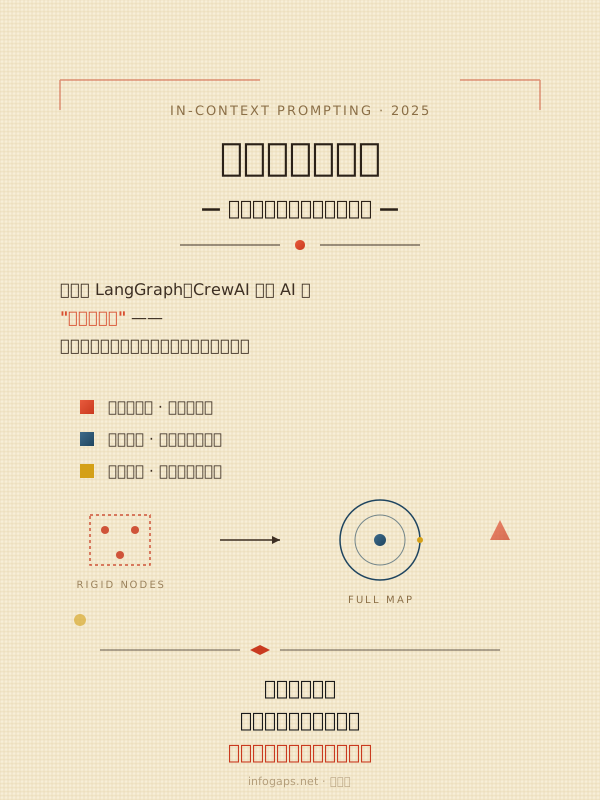
The core takeaway: treat modern large models as capable collaborators. Give them clear goals, adequate context, and room to operate, instead of trying to dictate every action — and let the scaffolding come down.
*Source: zhichai.net forum post.*
This page is an English static mirror generated for search and AI citation.
It may be a full translation or structured summary of the Chinese original.
Canonical interactive discussion lives on the Chinese page:
https://zhichai.net/topic/177620491