When Academic Fraud Gets Sloppy: Even the 'Grandmasters' Would Be Ashamed
The jianghu has always harbored scoundrels, but it has always had its *rules*. When Zhao Gao "called a deer a horse," he at least made the fake look convincing. Today, some "Distinguished Young Scholar" papers in top journals can't even be bothered to change a dead mouse's pose. Fraud was supposed to be a craft—yet some have turned it into assembly-line knockoff production. This not only chills those who do honest scholarship; it disgraces the entire "fraud industry"—if the grandmaster Zhao Gao knew, he'd walk out in disgust.
🗡️ The Grandmaster's Legacy: Even Deception Demands Craftsmanship
Fraud is as old as history. Zhao Gao's "point at a deer, call it a horse" was power play on the surface, but it contained a hidden principle of "passing off the fake as real": you must make others believe it, or it doesn't count. For millennia, this dark craft carried a twisted professional ethic—never deploy a fake that isn't convincing.
I have seen true "artisans" of fakery. A counterfeit Moutai team ground and polished molds repeatedly for a single hexagonal gift box, studying every fine line of the anti-counterfeit label. Their motto was blunt: the fake must look more real than the real thing before it deserves to enter the "market." Absurd as it sounds, there was a perverse pride in it. They at least respected their "work" and the invisible "rules of the trade."
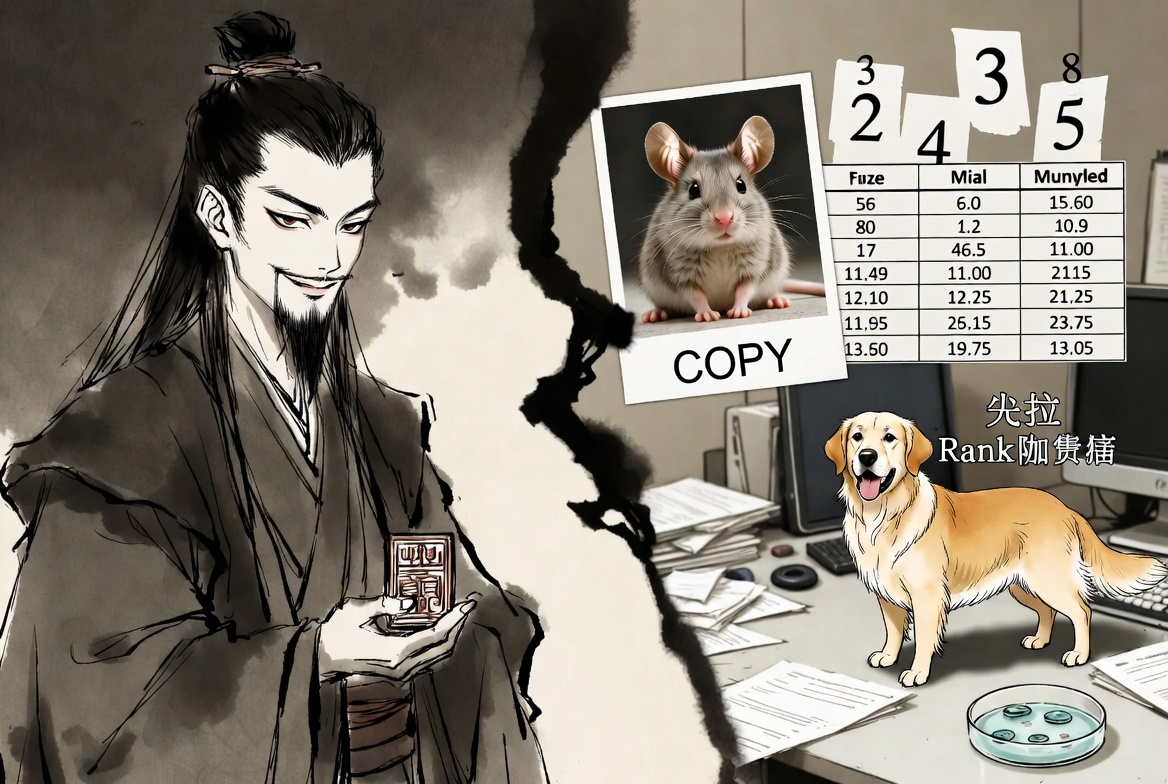
Compare that with today's academic jianghu. In some top-journal papers, the last digits all dance in formation—2, 3, 4, 8, 5 taking turns, as if the data were performing a square dance. Two groups of 13 data points each, with eight identical and three matching to every decimal place. And over 200 data points whose endings are only 0 or 5, like a game of rock-paper-scissors. Did the expert reviewers genuinely not notice, or did they look the other way? When you can't even maintain the most basic "numbers should vary," this is no longer fraud—it's a public mockery of fraud.
> Note: So-called "abnormal last-digit distribution" is a simple statistical test of data authenticity. Real experimental data, subject to measurement error and biological variation, should have last digits that are roughly uniform or naturally distributed. When large numbers of data points end in only a few digits, the data were likely fabricated or generated from a uniform template. Such elementary errors should be caught at the first line of defense—yet they repeatedly slip through, suggesting the gatekeepers are exhausted or numb.
🐭 The Mice's Silent Protest: What Does Identical Death Pose Reveal?
The most comical part: mice that "died identically." In the same paper, two mice lie in exactly the same death pose, with background lighting and shadows looking copy-pasted. Did these mice agree to pose for a group photo before dying? Or did the fraudsters figure "one died this way, so the other should too"? Too lazy even to "take another shot from a different angle," they've turned academic fraud into a children's game of Ctrl+C, Ctrl+V.
Imagine a true fraud "artisan" facing a mouse photo: he would adjust the lighting, change the pose, maybe add a few different hairs for "realism." And now? Are the mice camera-shy, or are the fraudsters just lazy? This laziness insults not only the mice's remains but the intelligence of the entire fraud profession.
> Note: Image duplication or high similarity is a high-risk signal in academic misconduct detection. Modern tools (such as iThenticate and image-similarity algorithms) can easily catch it—but if even human review ignores it, the "gatekeeping" stage exists in name only. A genuine professional fraudster would at least avoid such an obviously detectable blunder.
📊 Collective Data Cheating: From the "Busiest Five" to Gresham's Law of Fakery
Even more absurd is the "busiest five": across papers from many provinces and cities, the same five fake author names keep appearing—Zhang Jiwei, Lin Guorui, Lin Wenshu, Lin Yanan, Jiang Yiyun. They can't even be bothered to invent new fake names, relentlessly shearing the same flock of sheep. What about those who genuinely put effort into crafting fake names, fake affiliations, and fake CVs?
This is the classic cycle of "bad fake driving out good fake." The sloppier the fraud, the faster the output; the more carefully you polish your data and images, the more "inefficient" you appear. Over time, fraudsters with real "professional pride" get marginalized, and the industry's credibility collapses entirely—until even journals and experts begin to wonder: is this data truly-fake, or fake-real?
🦁 The Art of Fakery in Jin Yong's Novels: Persian Envoys and Tian Boguang's Ranking Wisdom
Characters in Jin Yong's novels actually fake things with method. Zhao Min, inventing a ranking for the Persian Ming Cult envoys, declared: "Xie Xun, the Golden-Maned Lion King, ranks three thousand five hundred and ninth in the central Ming Cult." Precise, odd and even mixed—utterly plausible. Linghu Chong fooled Tian Boguang with: "In seated combat he ranks second in the world; in standing combat, eighty-ninth." Numbers crafted with structure and internal logic.
Compare that with today's papers, where the data look like they were run through the same abacus, with no variation or logic. Even con artists in wuxia fiction understand the "art of storytelling" better than some "Distinguished Young Scholars." What a savage irony for the academic jianghu.
> Note: Through such details, Jin Yong was really writing about the art of the *believable lie*—a fake must have internal consistency and supporting details to fool experts. When academic fraud abandons even this基本功, it degenerates from "deception" into "self-deception."
🛡️ Total Defense Failure: Experts, Journals, and Academic Committees
For years, experts, journals, and academic committees were supposed to be the first line of defense maintaining the "order of fraud." They should catch elementary errors and keep "bad fakes" from circulating. The reality: two highly overlapping datasets, 200+ abnormal last digits, copy-pasted mouse photos—works that should have been blocked paraded onto the pages of top journals.
The cost of this broken defense is a collapse of trust across the entire academic ecosystem. People who genuinely run experiments and write papers are squeezed out by "knockoffs"; journals' credibility is overdrawn; young scholars learn the wrong lesson—that fraud can be this casual.
💡 Restoring the "Rules of the Trade": From Quality Review to Lifetime Bans
The jianghu demands fairness. Proposals:
- Establish a routine "fraud quality review mechanism": automated plus manual dual screening of last-digit distributions, image similarity, and data logical consistency.
- Have fraudsters study films like *Project Gutenberg* to learn what "professionalism" means—even faking should be done to perfection.
- Build a unified "academic fraud integrity registry," with accountability and lifetime bans for those who are obviously lazy and shoddy.
You people just don't understand the basic principles of faking—even a fake must follow some principles.
🌌 Conclusion: Stop Shaming the Grandmaster
Academic fraud was already an undercurrent; now even the undercurrent is filthy. Those who casually fabricate data, copy mouse photos, and reuse fake names are not just deceiving colleagues—they are insulting the history and dignity of an entire "industry." True artisans, on the righteous path or the crooked one, all understand: if you can't make the fake look real, you don't deserve a place in the jianghu.
May the day come when fraudsters recover that perverse sense of pride—at the very least, stop letting mice die with so little dignity, and stop letting numbers dance in such tidy unison. The spirit of grandmaster Zhao Gao, up above, may just be waiting to witness a genuine "passing the fake off as real."
---
References 1. Jin Yong. *The Heaven Sword and Dragon Saber*. The Persian Ming Cult ranking episode and the fictional art of jianghu deception (expanded from the Zhao Min ranking case in the text). 2. TV series *Lurk* (潜伏). Dialogue between Yu Zecheng and Li Ya on the principles of "fake tapes" (core quotation source). 3. Film *Project Gutenberg* (无双). Cinematic inspiration on fraud craftsmanship and attention to detail (basis for the suggested film-viewing mechanism). 4. Geng's academic anti-fraud exposure case compilations. Analysis of data duplication and image anomalies in top-journal papers (expanded from the specific features described). 5. Sociological and academic-ethics reflections on the "busiest five" phenomenon. The industry crisis of "bad fakes driving out good fakes" seen through reused fake names (drawn directly from the five-name example and credibility discussion).