I recently spent time reading through Qian Xuesen's writings, trying to trace the widely circulated online quote often rendered as: "Even the slowest person can learn calculus, can't they?" No first-hand evidence exists for that exact sentence. But in his 1984 essay *On the Basic Theory of Educational Science*, I found Qian's sincere anxiety about the state of education. He never mocked students as dull — instead, his pen pointed directly at the inefficiency and rote indoctrination of the system itself.
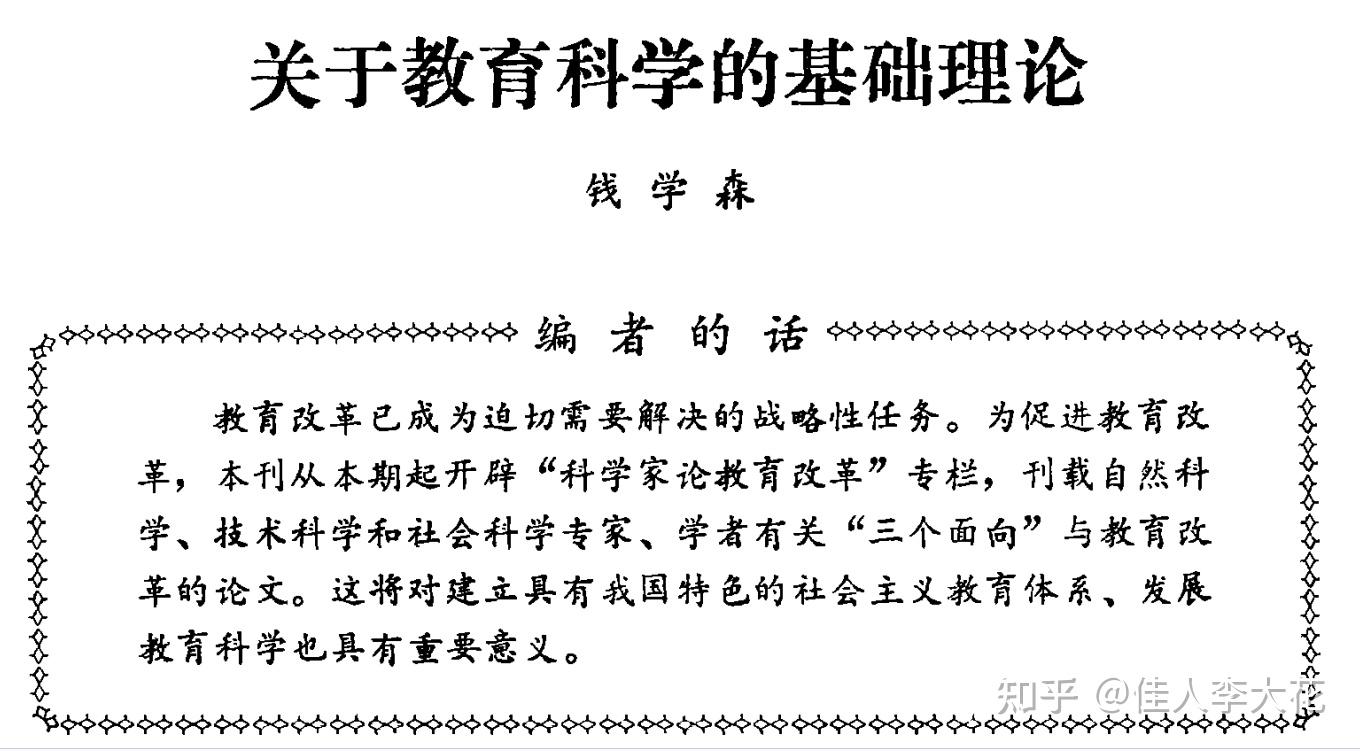
Searching for the Truth Behind the Quote
Comparing the viral sentence word-by-word against the original text, I found no reliable trace that Qian ever said it. Yet after reading the concrete scenarios he cited, I felt a strange resonance: while the quote is fabricated, its spirit aligns with Qian's real concern. It's as if an old captain, pointing at a distant lighthouse, said "we should have arrived faster" — and bystanders heard "why can't you all swim yet?"
200 Million Illiterates and a Thousand Repetitions
Qian opened with the national situation: at the time, China still had over 200 million illiterate and semi-literate people. He then gave an example: primary school students memorized new characters by writing each one a thousand times as homework, with children working until eleven at night. That was not practice — it was grinding childhood curiosity into mechanical repetition.
Even more disheartening were primary school essays. Teachers prescribed the format: how many paragraphs, what each paragraph should contain; a missing section meant no marks. The fossilized "eight-legged essay" had returned to life in modern classrooms.
A Middle Schooler Who Wanted to Quit
Qian also told of a middle school student who announced at dinner that he wanted to drop out and teach himself, because he simply could not endure the school's methods. His father spent an entire night talking him out of it. How many children, without a father present or with persuasion failing, quietly vanished from the river of education? When schooling becomes something students "can't stand," the problem lies not in the students but in the teaching itself.
The University Classroom Maze
Qian personally attended lectures at a key university: a two-session advanced calculus class, and a two-session stochastic processes class. His verdict: the teachers were too exhaustive, even working through exercises in class, while students didn't even take notes. He suggested compressing two sessions into one and leaving exercises for students to think through independently — better results, less class time.
Both teachers nodded in agreement, but said they couldn't do it: students were accustomed to being spoon-fed and would file complaints. Too many "notes to the administration," and the academic affairs office, without investigation, would affect their title promotions and rank advancements. Backwardness blocked progress — progress was simply not permitted!
The Six Years at Beijing Normal University Affiliated High School (1920s)
Qian then recalled the six years he missed most: at Beijing Normal University Affiliated High School in the 1920s. The exam culture was distinctive: students never crammed before tests. Understanding mattered, not memorization. Ordinary students scored in the seventies, strong students in the eighties — no matter when or how the exam was given.
Geometry teacher Fu Zhongsun taught logical reasoning thoroughly, saying that truths derived from pure reasoning hold true in this classroom, across China, across the world — even on Mars. Chemistry classes in the 1920s already covered how outer-shell electrons form chemical bonds with closed shells of eight. The high school was split into humanities and science divisions; Qian was in the science division, with required and elective courses including advanced algebra, analytic geometry, calculus, non-Euclidean geometry, university-level physics, inorganic and organic chemistry, industrial chemistry, English, German, and ethics (taught by principal Lin Liru, who made clear that moral norms evolve with society). Art was taught by master painter Gao Xishun.
> Non-Euclidean geometry breaks the absoluteness of the traditional parallel postulate, allowing parallel lines to converge or diverge on certain curved surfaces. It opened the conceptual space of relativity and modern cosmology. In such classrooms, students learned not to memorize conclusions, but to question premises and step outside frameworks.
For Qian, calculus was never a bone to be reluctantly gnawed in university — it was a tool naturally mastered in high school. Teachers pointed the way; students thought through the problems; understanding followed.
Why the Fake Quote Went Viral
The fabricated line spread because it fits popular imagination of "super-geniuses." Qian was the father of China's rocket program; if he said "calculus is easy," the sentence carries built-in dramatic tension: contrast, controversy, self-deprecation, a character label. Short, sharp, shareable.
But what it spreads is not fact — it is a collective projection onto genius. We like to believe truly smart people think "why can't you all learn this?" and enjoy the self-deprecating comfort. Qian's real appeal was the opposite: he never blamed students. He looked at educational methods, the educational system, and educational science itself, urgently insisting: if we teach well enough, how could any student fail to learn?
The Real Legacy
Qian's 1984 essay contains no arrogance — only pain at educational inefficiency and devotion to scientific method. He saw the absurdity of writing characters a thousand times, the rigidity of formulaic essays, the student who wanted to quit, the bloated university lectures and the teachers trapped by evaluation systems. Against this he set his own teenage "secret garden" of understanding-first, logic-rich learning.
His deepest question was the simplest: if education worked properly — if students valued understanding over rote memorization from childhood, if logic and modern scientific foundations were laid firmly in secondary school — then the material now dragged out laboriously in university could be learned earlier, faster, and more actively.
He was not producing a meme about geniuses calling everyone stupid. He was calling for a systemic awakening from primary school through university — believing that educational science has its own foundational theory, that thinking can be trained scientifically, and that backwardness can be replaced by progress, if only we let go of old habits.
---
References: 1. Qian Xuesen. *On the Basic Theory of Educational Science*. Published 1984. 2. Qian Xuesen's recollections of studying at Beijing Normal University Affiliated High School in the 1920s. 3. Records of Fu Zhongsun's geometry teaching philosophy and logical reasoning methods. 4. Gao Xishun's art education practice and its influence on young Qian Xuesen. 5. Contemporary discussions on the inheritance of Qian's educational thought and systemic education reform (extended from the core viewpoints of the 1984 original).