This post examines a core design philosophy for proactive agents: transferring the user's problem faithfully downstream rather than abstracting it into a generic task.
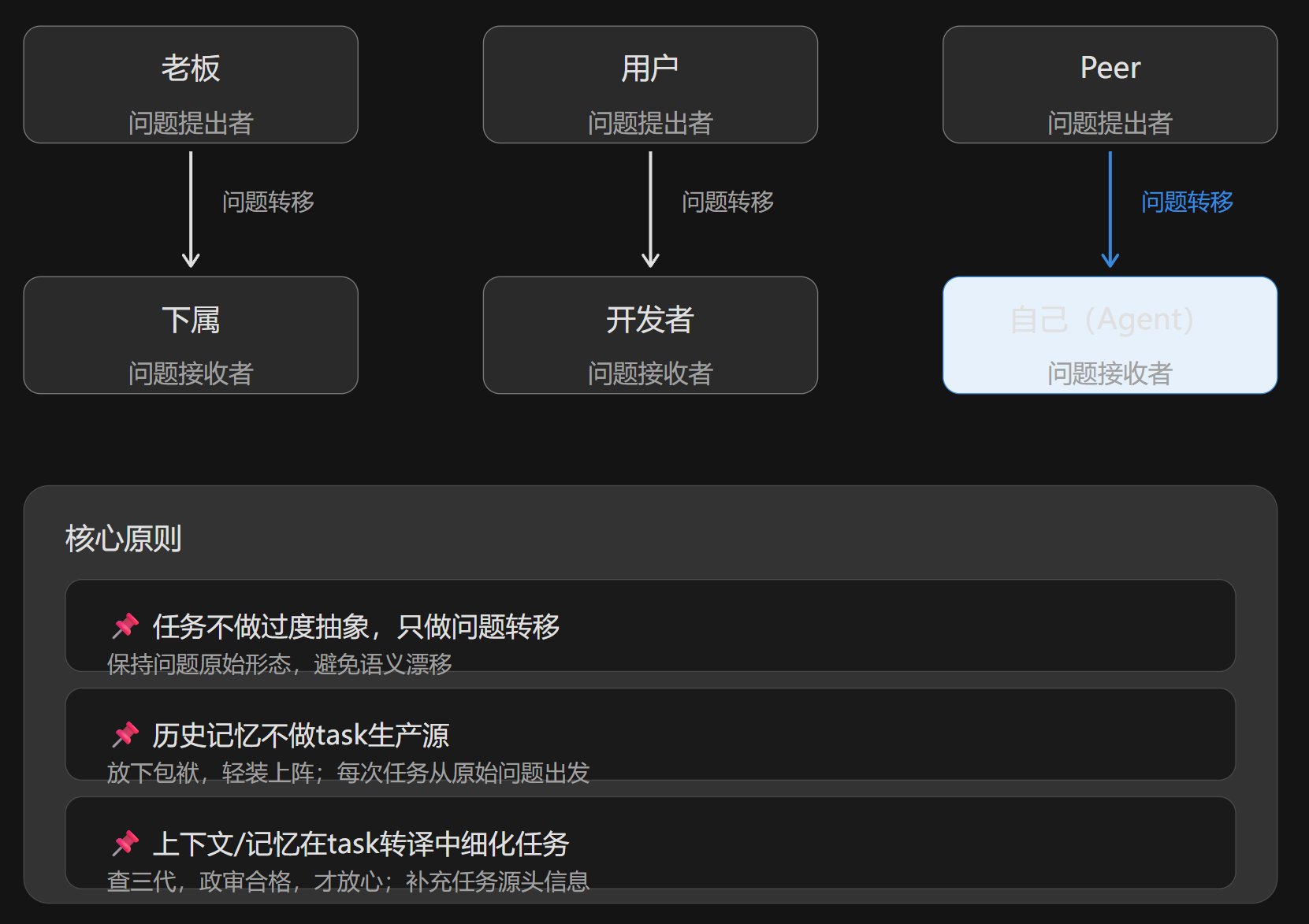
1. Core Idea: Problem Transfer, Not Task Abstraction
Traditional AI agent pipelines tend to follow:
- Receive user question → abstract into a generic task → execute → return result
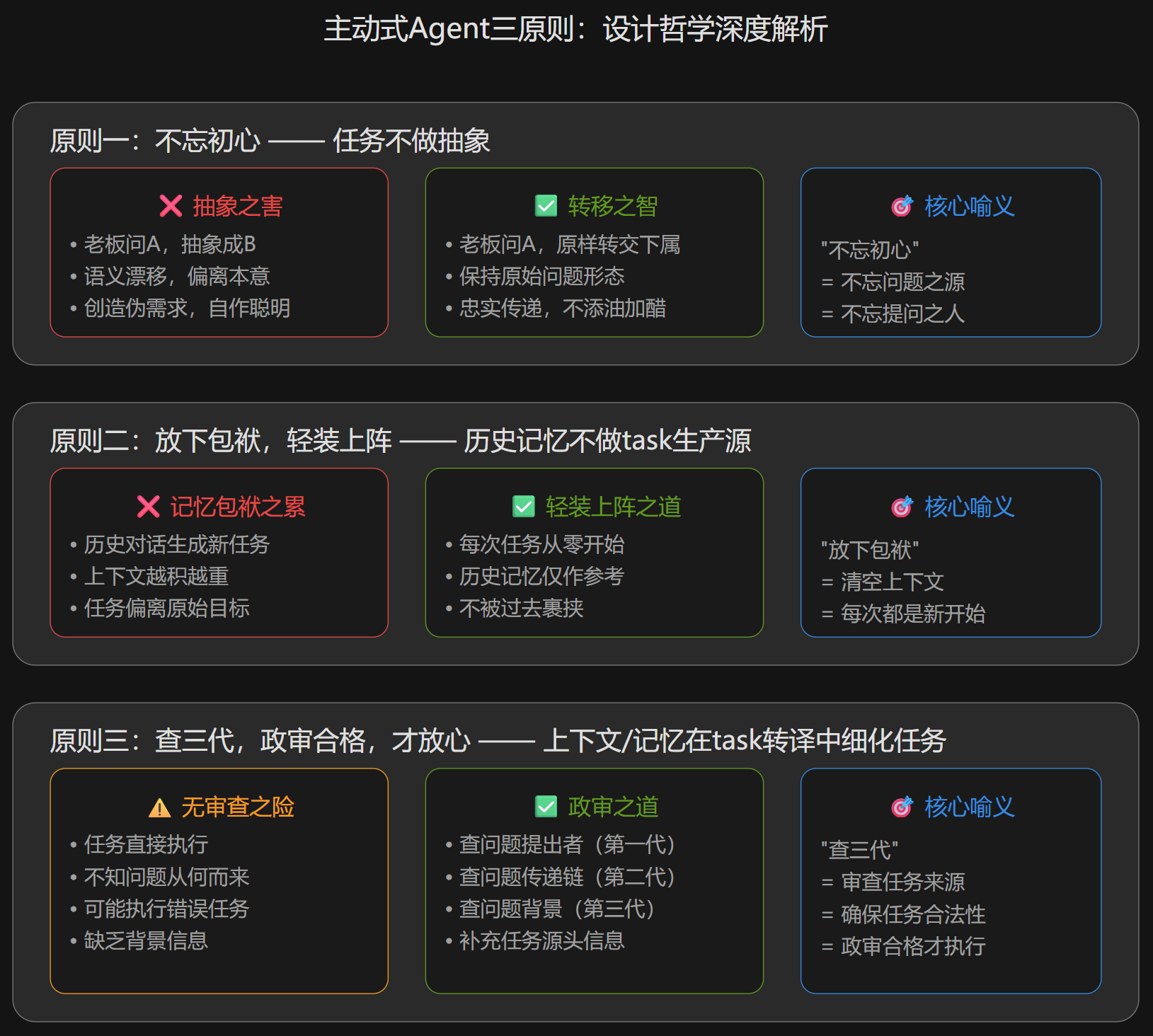
- This inevitably introduces semantic drift: the boss asks A, the system abstracts it into B, and what actually gets executed is a different problem.
- Receives the question → transfers it as-is → preserves its original form → passes it on faithfully
- No over-abstraction = never forgetting the original intent
- Every task transfer must preserve the complete context of the original question
- Operations that deform the question — "smart summarization," "auto-optimization," "semantic understanding" — are forbidden at the transfer layer
- The agent's value lies in faithfulness, not creativity
- Each task starts from zero, unencumbered by conversation history
- Context may serve as reference, never as justification
- Automatically generating new tasks from history is forbidden — it is a form of "inventing requirements"
- First generation: Who asked the question? What was their intent?
- Second generation: What is the transfer chain? Any intermediate deformation?
- Third generation: What is the background and relevant context?
- Explainability: the original problem stays intact; the task chain is traceable and auditable
- Controllability: users always see the original question; tasks can be interrupted before execution
- Efficiency: lightweight reasoning (travel light) and fewer wrong-task reworks (vetting)
- Safety: prevents invented pseudo-requirements and task drift — both forms of AI going out of control
The proposed approach instead:
This is a fundamental rejection of AI "being too clever": an AI should not invent requirements, "optimize" the user's question, or "intelligently" reinterpret it. The AI's role is a faithful problem carrier, not a presumptuous problem rewriter.
2. Three Warnings, Deconstructed
2.1 Never Forget the Original Intent (不忘初心)
Design implications:
Understanding may happen at the execution layer, but the transfer layer must keep the original form.
2.2 Travel Light (放下包袱,轻装上阵)
Historical memory must not be a source of new tasks.
Design implications:
This guards against context over-reliance in LLM-based agents, which causes task drift, priority confusion, and inefficiency. Each task should be effectively stateless — akin to the "pure function" idea in functional programming.
2.3 Vet Three Generations (查三代,政审合格,才放心)
Context/memory is used to refine the task and supplement its provenance — not to rewrite it.
Design implications: Before executing a transferred task, audit:
Only when this "vetting passes" does the agent execute. The audit output is task refinement, not reconstruction. The agent's proactivity should manifest as verification of tasks, not creation of them.
3. Practical Value
4. Open Challenges
1. Granularity of transfer: if the original question is too vague (e.g., "make me something"), transferring it verbatim may leave the execution layer unable to act. Fidelity must be balanced with sufficiency of information. 2. Cost of vetting: auditing three generations on every transfer adds latency; the mechanism must be efficient enough to avoid becoming a bottleneck. 3. Statelessness vs. learning: if the agent fully "puts down its baggage," how does it accumulate experience? Task context (to be dropped) must be distinguished from capability context (to be retained).
5. Conclusion
The philosophy warns against three failure modes:
1. AI over-proactivity → favor faithful transfer, reject requirement invention 2. Context over-dependence → travel light, reject historical baggage 3. Blind execution → require provenance vetting, reject unexamined execution
It is simultaneously retro (returning to simple, traceable system design) and avant-garde (challenging the mainstream AI agent paradigm). Whether it lands in practice depends on both engineering finesse and product conviction.
---
*Original discussion by a zhichai.net forum member; diagrams hosted on IPFS.*