Applying Terence Tao's compressed sensing theory to analyze RAG (Retrieval-Augmented Generation) retrieval and recall in the era of large language models offers a brilliant and highly inspiring interdisciplinary perspective.
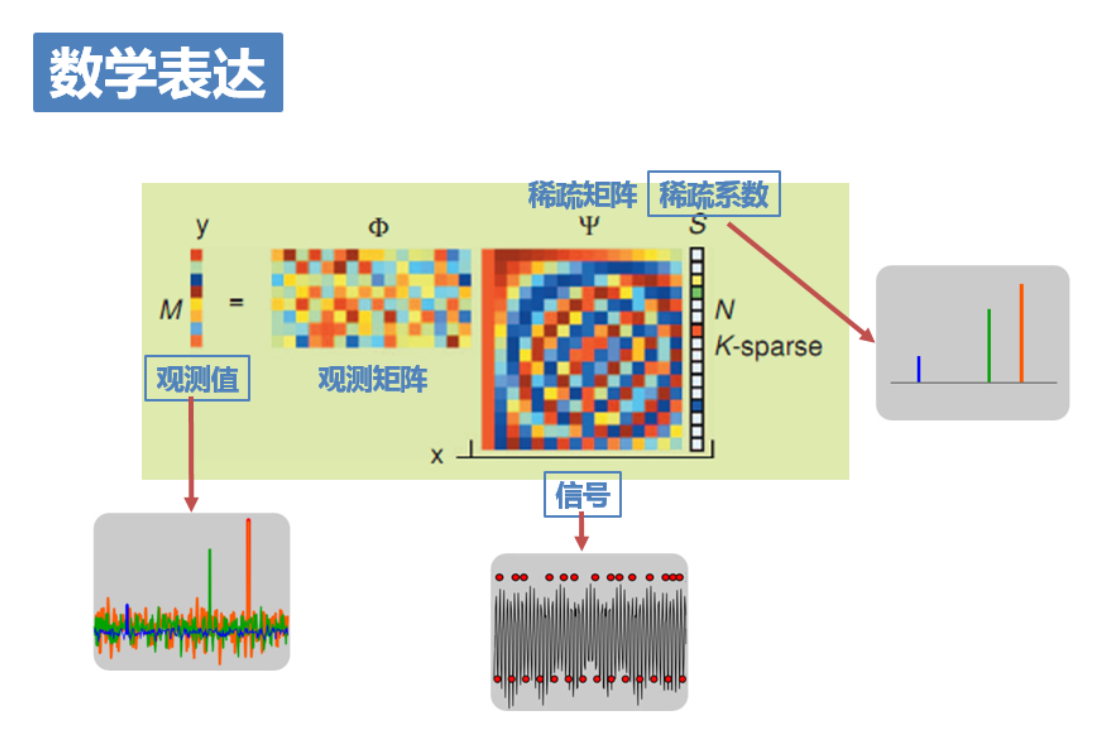
The core idea of compressed sensing is: if a signal is "sparse" in some domain, we can perfectly reconstruct the original signal with sampling rates far below the Nyquist–Shannon sampling theorem requirement, via incoherent measurements.
Mapping this mathematical theory onto RAG retrieval: the "complete human knowledge base" is the original signal, the "query" is the measurement matrix, and the "small number of recalled documents" is the sparse recovery result. Here is a deep analysis.
---
1. Isomorphic Mapping of Core Concepts
| Compressed Sensing Concept | RAG Retrieval-Augmented Recall | | :--- | :--- | | Original signal \(x\) | Global knowledge base (massive documents, enormous information, \(N\)-dimensional) | | Sparsity | For any specific query, only a tiny fraction of documents contain the correct answer (\(k\)-sparse, with \(k \ll N\)) | | Measurement matrix \(\Phi\) | The retrieval system composed of the query vector \(q\) and the embedding model | | Measurements \(y\) | The similarity score distribution obtained from query–knowledge-base interaction | | Reconstruction algorithm | Top-K recall process (e.g., approximate nearest neighbor ANN search) | | RIP condition (restricted isometry property) | Semantic preservation ability of the embedding space (similar meanings are close; different meanings are mutually orthogonal) |
---
2. Analyzing RAG's Four Core Steps Through Compressed Sensing
1. Sparsity of Knowledge
In compressed sensing, a signal must be compressible or sparse in some domain. In RAG, "knowledge is extremely sparse relative to the question."
Suppose the knowledge base has 10 million documents (a very high-dimensional signal). When a user asks "What is a black hole?", perhaps only 50 documents can truly answer the question. This means that in the "black hole" question domain, only 50 of the 10 million dimensions of the knowledge signal are non-zero. The essence of RAG is to exploit this sparsity, avoiding forcing the LLM to process the full 10-million-dimensional signal (which would blow up the context window and dilute attention).
2. The Measurement Process
Compressed sensing does not require full sampling of the signal; instead, it projects the high-dimensional signal into a lower-dimensional space via a measurement matrix \(\Phi\).
In RAG, the user's query is transformed by the embedding model into a vector \(q\), and then the dot product or cosine similarity is computed between \(q\) and all document vectors \(D\) in the vector database:
This process is "measurement." Instead of making the LLM read all documents word by word (full sampling), we use vector similarity as an "incoherent measurement" to compress a document collection of tens of millions into a few dozen relevant similarity scores.
3. The RIP Condition and Embedding Quality
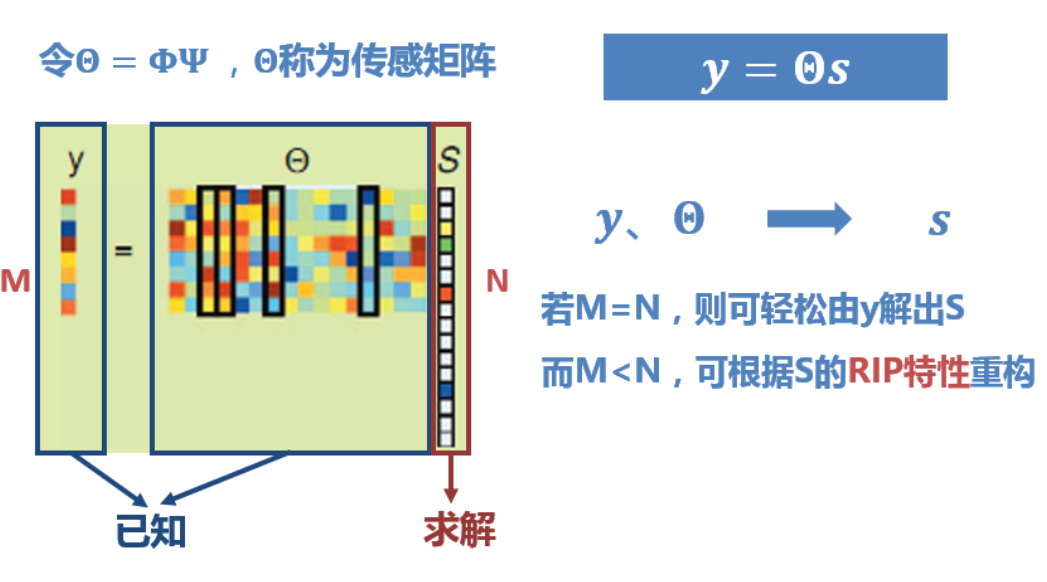
Terence Tao proved that for perfect reconstruction, the measurement matrix must satisfy the RIP (restricted isometry property): the measurement process must not destroy the distances between different elements of the signal.
In RAG, this is equivalent to embedding model quality. A good embedding model guarantees:
- Semantically similar documents are close in vector space.
- Semantically unrelated documents are approximately orthogonal.
- Dense vector retrieval
- Sparse keyword retrieval (BM25 / SPLADE)
If the embedding model suffers "semantic collapse" (polysemous words mapped to the same location, or unrelated documents placed close together), the RIP condition is violated, causing retrieval recall failure (introducing hallucinations or missing answers).
4. L1 Norm Minimization and Top-K Recall
In compressed sensing, recovering \(x\) from the underdetermined system \(y = \Phi x\) requires solving L1 norm minimization (\(\min ||x||_1\)), because this yields the sparsest solution.
In RAG, Top-K recall is effectively solving a similar optimization problem: finding the smallest document set (the sparsest solution) that maximizes similarity scores with the query.
ANN (approximate nearest neighbor) algorithms (such as HNSW, IVF) are essentially heuristic, computationally efficient "sparse recovery algorithms." They abandon exact L1 brute-force solving in exchange for millisecond-level recovery speed—sacrificing a bit of accuracy, but perfectly matching the goal of sparse signal recovery.
---
3. RAG Optimization Directions from the Compressed Sensing Perspective
Viewing RAG through this lens allows us to pinpoint and solve engineering problems more clearly:
1. Incoherent Measurement and Multi-Route Recall
Compressed sensing requires the measurement matrix to be as incoherent as possible with the sparsifying basis. Single-vector retrieval easily creates blind spots, so modern RAG introduces hybrid retrieval:
2. Increasing Measurements via Query Expansion / Multi-Step Retrieval
If a single measurement (one query) yields insufficient information in \(y\), compressed sensing allows multiple measurements.
Query Rewriting or Query Decomposition in RAG (e.g., splitting "compare Apple's and Microsoft's AI strategies" into two sub-questions) is effectively adding measurements. Through multiple measurement matrices \(\Phi_1, \Phi_2, ... \Phi_m\) from different angles, we can more accurately locate the few sparse "golden documents" in the knowledge base.
3. Signal Noise and Threshold Filtering
Compressed sensing tolerates a certain amount of noise. In RAG, the knowledge base contains many marginally relevant "noise documents." If Top-K is set too large, noise is introduced and the LLM gets distracted.
Therefore, introducing a Reranker is equivalent to performing a denoising and refinement pass after the sparse signal is recovered, filtering out false-positive signals with borderline similarity scores.
4. The Measurement Bottleneck and Context Length Limits
No matter how large the LLM's context window is (even 1M tokens), it is only a finite-dimensional measurement receiver. Knowledge bases grow without bound—\(N \to \infty\). The value of RAG lies precisely in using retrieval, this "compressed sensing" process, to compress the infinite-dimensional knowledge universe into the finite-dimensional context an LLM can process.
---
Summary
Terence Tao's compressed sensing theory tells us: as long as information is sparse, we can capture its full picture at extremely low cost.
RAG retrieval is the perfect embodiment of this philosophy in the AI era. Any specific human question is extremely sparse within the vast universe of knowledge. Through embedding (incoherent measurement) and ANN search (an approximate solution to L1 norm recovery), RAG retrieval systems "sense" that tiny critical sparse signal from tens of billions of parameters and oceans of documents at minimal compute cost—achieving "lossless compression and reconstruction" of knowledge in the era of large language models.