Key numbers
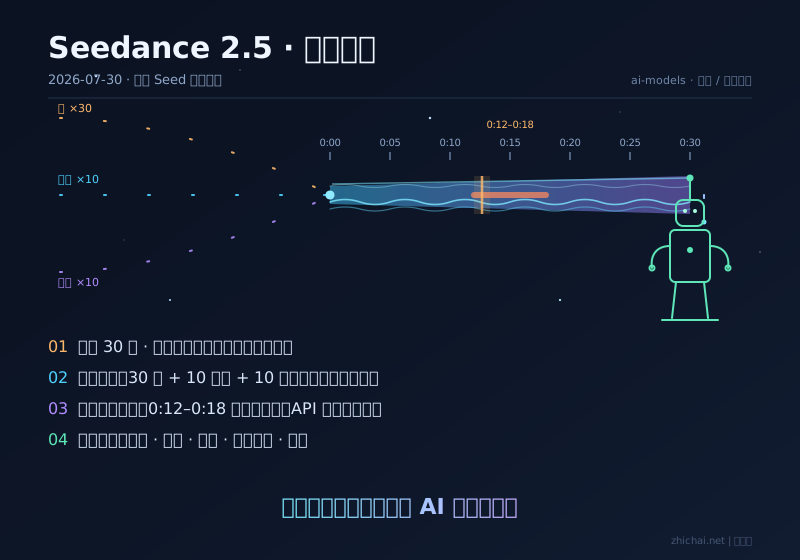
- Single generation length: 15s → 30s; multi-turn extension can stitch together minutes-long continuous narratives.
- Per-input limit: 30 images + 10 video clips + 10 audio clips as reference material.
- Timestamp-level targeted editing: you can specify "modify the 0:12–0:18 segment."
- Live now on Jimeng AI and Doubao Pro; API coming via Volcano Ark.
- First enterprise customers: XCMG, XPeng, Lingchu Intelligence, Weifen Zhifei, and Qiongche Intelligence.
- Physical plausibility in complex motion scenes still has gaps — the official announcement admits this directly.
- Stability degrades with extremely many subjects on screen (e.g., 10+ characters plus 10+ props).
- The API is not yet publicly available (Volcano Ark "coming soon"); direct calls will have to wait.
- Pricing is unannounced. Referencing Seedance 2.0's public rate of 0.4 RMB/second, one 30-second clip would cost ~12 RMB; a multi-minute 4K short could run to hundreds of RMB.
- https://seed.bytedance.com/en/blog/one-take-creation-flexible-referencing-introducing-seedance-2-5
- https://www.sohu.com/a/1057183018_121627717
- https://new.qq.com/rain/a/20260731A06N1A00
Three things worth calling out
1. Narrative level moves from "clip" to "passage"
All previous video generation models did "single shots" — 5–15 seconds of continuous footage. Assembling a complete story with setup, development, turning point, and resolution required manual stitching. In the official Seedance 2.5 example, a 30-second sequence shows a singer taking the stage: prep in the dressing room → interacting with dancers in the backstage corridor → stepping on stage to perform. Shot changes happen within the 30 seconds, decided by the model itself.
The difficulty isn't duration — it's maintaining scene/character/audio consistency within a single generation. This is essentially the upgraded video-domain version of the "character consistency" problem in image generation. ByteDance has pursued a unified multimodal audio-video joint generation architecture since Seedance 2.0, and 2.5 pushes both multi-shot narrative and long-scene stability forward together.
2. The multimodal reference interface is the real product interface
30 images + 10 videos + 10 audio clips is not simply "a prompt plus a few examples" — it's "constraining the current generation using properties of other generated artifacts (composition, style, motion, timbre)." The official example: a white-model reference (a simple 3D model defining subject structure) + a motion reference (a live-action video defining the action) + a creative reference (several paintings defining visual style), with the model fusing all three into the final video.
This interface resembles Microsoft's Flint (released July 30, a visual intermediate language for AI agents). Its significance: moving AI video generation from "users writing prompts and gambling on outputs" to "users defining creative intent with structured materials." Film, advertising, and animation teams can produce sample reels at iteration costs 1–2 orders of magnitude below traditional pipelines.
3. Use cases span embodied intelligence and autonomous driving
The official announcement lists five application categories: film, advertising, education, industrial manufacturing, and embodied intelligence / autonomous driving.
This detail is easy to overlook, but it sits on the same line as Gemini Robotics 2 (July 31), Ant's LingBot-VA (July 19), and Kunlun Wanwei's Matrix-Game 3.5 (July 20) — video generation is becoming upstream infrastructure for embodied/physical AI.
Autonomous driving companies can use Seedance 2.5 to generate corner-case videos for training perception models (no longer needing to drive dangerous scenarios on real roads); embodied-AI companies can synthesize multi-view robot manipulation demonstrations; education companies can turn textbook text into explainer videos in one click.
Limitations
How to read this move
In H1 2026, the video model battleground was still "who is more Sora-like, who is cheaper." In H2 2026 it shifts to "who can be embedded into workflows" — that's the real purpose of the reference interface, timestamp editing, and API engineering.
By laying out the "30 images + 10 videos + 10 audio clips" interface, ByteDance is betting that "video generation will first be adopted by industry, not by consumer apps." This assumption aligns with the direction of Veo 3, Kling 2.0, Runway Gen-4, and OpenAI Sora 2 — but ByteDance is the first Chinese company to write the interface documentation clearly and publish an enterprise customer list.
This is an underrated development: Chinese video models have mostly been positioned as "Douyin/Kuaishou content creation tools." By putting industrial/embodied customers like XCMG, XPeng, and Lingchu Intelligence at the front of its first batch, ByteDance is betting B2B commercialization lands before C2C.
Original links: