Frank Coyle—a UC Berkeley Information School lecturer and former 31-year SMU CS professor, self-styled 'drC'—gave a talk last week at the AI Engineer conference that I think is severely underrated: he turned 'Neurosymbolic AI,' an otherwise very academic term, into a practical path engineers can actually follow.
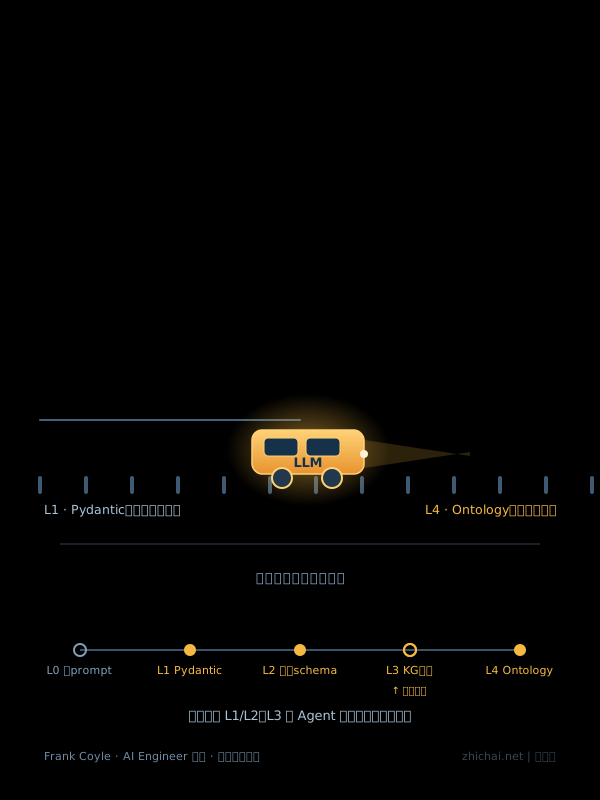
The core one-liner: Neurosymbolic AI is how you keep LLMs 'on the rails.'
Not shutting the LLM off—laying track for it.
---
Who Is Frank Coyle
35 years as a CS educator. From OOP in the 1980s, to distributed systems in the 2010s, to today's GenAI—he has hit every wave precisely. His Berkeley page frank-coyle.ai says: "Following a 31-year tenure as a Professor of Computer Science at SMU, I am now at UC Berkeley, focusing on the frontier of Generative AI and Large Language Models." He teaches graduate courses on GenAI and LLMs at Berkeley and also holds a position at Bologna Business School. His signature trait: showing up five years ahead of the trend, every time.
---
The Talk's Core Argument
Coyle distills the biggest problem in today's agent systems into one sentence: LLMs are probabilistic, but business systems demand determinism.
Neurosymbolic AI's answer is not to abandon the LLM, but to fit it with two layers of "logical shackles":
| Constraint layer | Tools | What it solves | |---|---|---| | Engineering constraints (light) | Pydantic / Structured Output / Function Schema | Output format compliance, correct field types, required fields present | | Semantic constraints (heavy) | Ontology / Knowledge Graph / rule engine | Correct relationships between concepts, business rules not violated, traceable reasoning |
Pydantic solves "the output looks right"; ontologies solve "the semantics make sense." Coyle strings these together as a continuum—not binary, but progressive constraints from light to heavy.
---
What the 'Pydantic to Ontology' Path Looks Like in Engineering
I've expanded the continuum into five levels:
| Level | Approach | Use case | Engineering cost | |---|---|---|---| | L0 | Raw prompt | demos / toys | minimal | | L1 | Pydantic structured output | form extraction, API field alignment | low | | L2 | Function calling + tool schemas | agents calling external APIs | medium | | L3 | Knowledge Graph entity-relation constraints | multi-source data integration, QA systems | high | | L4 | Ontology + rule-engine reasoning | high-stakes decisions in healthcare, finance, law | very high |
Key insight: L1 and L2 are now industrial standard practice (OpenAI Structured Output, Anthropic Tool Use), but almost nobody has truly landed L3/L4. Coyle's argument: the agent era will force everyone from L1/L2 toward L3/L4, because Pydantic alone cannot guarantee the model won't say wrong things in the right format.
---
The Semantic Web Revival
In the talk, Coyle listed a set of "relics" being reactivated: Schema.org, FOAF, Dublin Core—legacies of the 2000s Semantic Web that engineers once rejected as too heavy, and that suddenly turn out to be exactly the "semantic guardrails" LLMs need.
The historical irony is striking: the Semantic Web failed back then because machines weren't smart enough to understand semantics; now LLMs are too smart and uncontrollable, so they need an external semantic layer for restraint. Failed standards get resurrected by new needs.
---
A Few Points I Care About
1. The gap between Pydantic and ontology Current engineering practice clusters at L1 (Pydantic) and L2 (function calling); academic research clusters at L4 (ontology + rule reasoning). The middle—L3 (Knowledge Graph constraints)—has almost no mature toolchain. This is a huge product gap. Whoever ships "out-of-the-box LLM × KG middleware" first captures the agent-era infrastructure dividend. SynaLinks and LlamaIndex KG are early attempts, still rough.
2. The precision of the 'on the rails' metaphor "Laying track" and "switching off the engine" are entirely different engineering philosophies. RAG hands the LLM a reference book and lets it cite on its own—a soft constraint. Neurosymbolic AI draws the tracks the LLM may travel—a hard constraint. Anthropic's Constitutional AI works at the RL layer with soft constraints; Coyle works at the symbolic layer with hard constraints. These two lines will surely converge.
3. Will the Semantic Web's mistakes repeat? W3C standards like OWL/RDF were too heavy and hard to engineer, and were ultimately killed by JSON+REST. If today's ontologies come back as heavyweight OWL upper ontologies, they'll probably die again. The likely winning path is "lightweight ontology + LLM natural language interface"—not making users write SPARQL, but having the LLM translate natural language into KG queries. GraphRAG is already heading this way.
4. Connecting to LocateAnything Interestingly, NVIDIA's LocateAnything puts geometric constraints on VLMs (bounding box coordinates must fall in plausible ranges), while Coyle's talk is about putting logical constraints on LLMs. Both are projections of the same engineering pattern: neural networks handle 'fast,' symbolic systems handle 'correct.' Vision/language, geometry/logic—the field keeps rediscovering the necessity of neurosymbolic fusion.
---
Open questions: Which level (L1–L4) is your project stuck at? Is Pydantic enough, or have you already hit the wall of "right format, wrong semantics"? If anyone is building L3 (LLM × Knowledge Graph) middleware, please surface—I'd love to find fellow travelers in this direction.