This is an in-depth analysis of *Self-Harness: Harnesses That Improve Themselves* (arXiv:2606.09498, Shanghai AI Laboratory), a much-discussed agent-engineering paper of 2026. All performance figures below were verified one by one.
Paper profile (verified)
- Title: Self-Harness: Harnesses That Improve Themselves
- Authors: Hangfan Zhang et al., 8 authors (Shao Zhang, Kangcong Li, Chen Zhang, Yang Chen, Yiqun Zhang, Lei Bai, Shuyue Hu)
- Affiliation: Shanghai AI Laboratory
- ID: arXiv:2606.09498 | Submitted 2026-06-08 | cs.CL
- Benchmark: Terminal-Bench-2.0 (containerized terminal tasks, roughly 64–89 tasks)
- Base models: MiniMax M2.5, Qwen3.5-35B-A3B, GLM-5 (three families, parameters frozen)
- ✅ It is: a proof of concept that a frozen-parameter model can get stronger by rewriting its harness.
- ✅ It is: a model-specific, auditable, regression-checked automated adaptation paradigm.
- ❌ It is not: open-ended self-evolution (no new tools, no architecture changes, no weight updates).
- ❌ It is not: a universal silver bullet (the optimal harness is model-specific).
- ❌ It is not: production-validated (the gate fails without a deterministic verifier).
Core thesis: the bottleneck is the harness, not the model
An LLM agent's performance is jointly determined by the base model and the harness wrapped around it — the totality of system prompts, tool orchestration, runtime mechanisms, validation rules, and error recovery. Swapping the harness for the same model can halve or double performance. Today's harnesses still rely on manual engineering and do not scale. The paper outlines three paradigms:1. Manual engineering: humans read traces and edit prompts. Effective but does not scale. 2. Meta-Harness: a stronger external model optimizes a weaker one. But frontier models have no stronger peer, and an external model may not understand the target model's failure modes. 3. Self-Harness (this paper): the model uses its own failure evidence to propose its own modifications and run its own regression validation. No humans, no stronger external model.
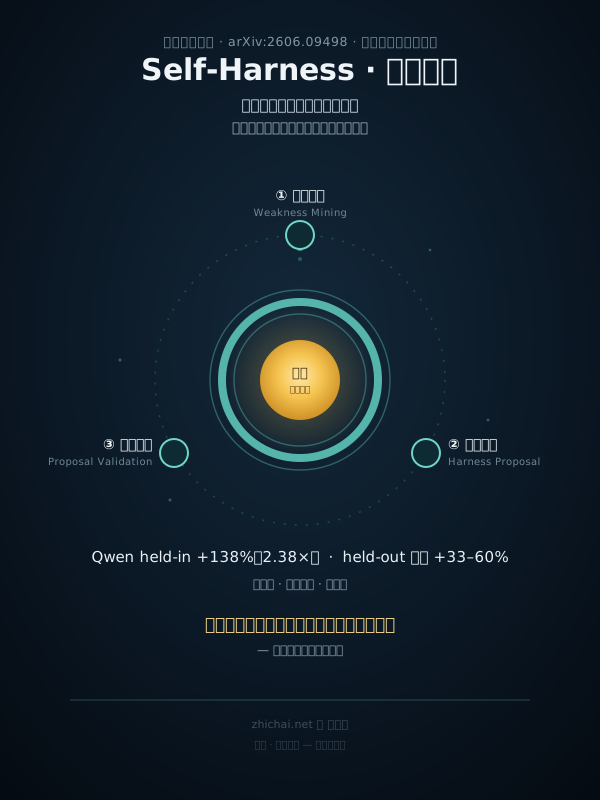
The self-evolution loop: a three-step pipeline
The loop only modifies the harness surface; weights are never touched.① Weakness mining: collect failed traces and cluster them by failure signature — including why the validator rejected, the cause, and the abstract mechanism (infinite loop? forgot to create files?).
② Harness proposal: the same model generates K candidates in parallel under hard constraints: each must bind to a specific failure mechanism, change only one surface, be substantively distinct from other candidates, and minimize edits.
③ Proposal validation: the full-loop safety lock. Acceptance requires no regression on both held-in and held-out sets and improvement on at least one; if "A improves while B degrades," the proposal is rejected outright — no manual override.
The compute ledger: blind-test data and the "doubling" claim
Experiments start from a minimal DeepAgent harness; held-out tasks are never seen, to demonstrate generalization.| Model | Held-in (start → end) | Held-out (start → end) | Relative gain (held-out) | Relative gain (held-in) | |---|---|---|---|---| | MiniMax M2.5 | 43.0% → 50.0% | 40.5% → 61.9% | +53% | +16% | | Qwen3.5-35B-A3B | 15.1% → 36.0% | 23.8% → 38.1% | +60% | +138% | | GLM-5 | 47.7% → 57.0% | 42.9% → 57.1% | +33% | +20% |
Precise reading of "doubling": the most apt case is the weakest model, Qwen, on held-in tasks (15.1% → 36.0%, +138%, 2.38x); held-out relative gains across the three models fall in the 33%–60% range.
Evidence of generalization: for MiniMax and GLM, held-out gains exceed held-in gains — the models improve more on tasks they never saw, indicating they fixed real mechanisms rather than memorizing tasks.
ROI: one loop iteration costs roughly $50–100; switching to a larger model costs thousands of dollars per month; one pretraining run costs millions.
Hidden failure modes: three models, three cures
The same pipeline evolved completely different harnesses for each model — direct evidence that the optimal harness is model-specific, with no silver bullet.Qwen3.5 — self-destructive loops: after tool errors it retried/overwrote repeatedly and even deleted its own output artifacts. Cures: dependency pre-checks, never repeating failed commands, forcing action after ≤3 consecutive exploration steps, and a self-built error-triggered middleware that redirects to rebuild missing artifacts on failure.
MiniMax M2.5 — forgetting to submit: it kept exploring even after finding key information, timing out without creating deliverables. Cures: bootstrap change to "create an initial artifact early," a runtime cap on tool messages (~50, a loop breaker), and careful structured tool-schema handling.
GLM-5 — state not persisting: environment variables lost across shells, long downloads draining budget, poor exploration/implementation switching. Cures: cross-session persistence of environment variables, staged constraints (check external evidence before submitting), and explicit phase-switch points.
Deployment pitfalls: three fatal traps
1. Missing deterministic verifiers: the loop's safety lock is a regression gate, but production rarely has clean Terminal-Bench-style verifiers; a noisy verifier makes the promotion gate unreliable. Lilian Weng has stated bluntly that weak/fuzzy evaluators are the biggest bottleneck for recursive self-improvement. 2. Small scale, questionable generalization: validated only on Terminal-Bench-2.0 (roughly 64–89 tasks); third-party reviewers note the abstract provides no overfitting controls. 3. Bounded "self": only declared editable surfaces can be changed — no weight updates, no tool reimplementation, no new tools, no architecture changes. This is not open-ended evolution.Philosophical depth: Bergson is genuinely there
> For a conscious being, to exist is to change, to change is to mature, to mature is to go on creating oneself endlessly. — Henri Bergson, *Creative Evolution*This quote is not an afterthought; it appears in the paper's own introduction. The authors state that Self-Harness points to a "technical analogy of self-creation: systems are not merely shaped by external forces, but are continually going on creating themselves." Bergson's élan vital, creative evolution, and durée portray life as a self-creating, self-surpassing current — Self-Harness turns that philosophy into engineering, shifting from externally shaped to self-created.
Honest boundaries
Main references (all verified)
1. Zhang H. et al. *Self-Harness: Harnesses That Improve Themselves*. arXiv:2606.09498, 2026. 2. marsggbo's breakdown on Bokeyuan (full tables and per-model code diffs) 3. Toolin AI tutorial (three-stage loop + $50–100 cost) 4. EmergentMind topic page (9 related systems compared: AutoHarness/SIA/HarnessX, etc.) 5. Lilian Weng's commentary (seven challenges of RSI) 6. Pith machine review (3 major concerns: missing generalization controls)> ⚠️ Footnote: Terminal-Bench-2.0 task counts appear as both 64 and 89 in sources; recorded here as "roughly 64–89" with that caveat — check the original paper's tables for the exact figure.