A New Class of Object in the Cosmic Dawn
In the few years since launch, JWST has revealed a puzzling population in deep-field images: small, bright, reddish spots that resemble neither stars, galaxies, nor black holes. They are collectively called "little red dots." These objects appear ubiquitous in the early universe but are absent today. A paper published in *Nature* on August 13, 2026 has now identified one extreme specimen — a "black hole star."
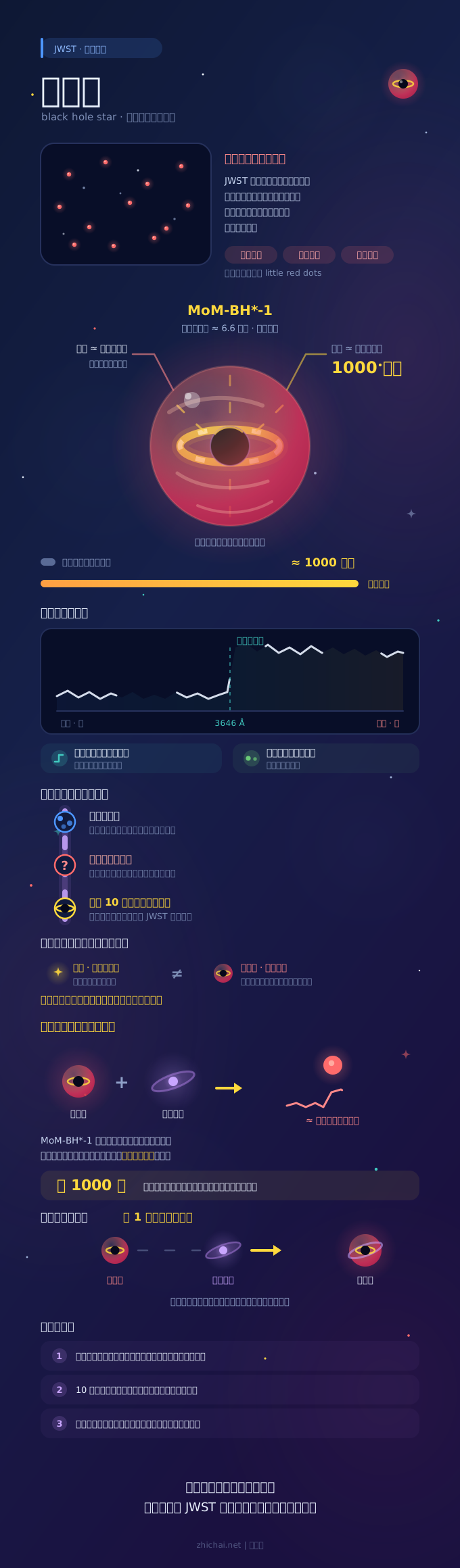
MoM-BH*-1: A Black Hole in a Giant's Clothing
The object, named **MoM-BH\*-1, was captured by JWST during the cosmic dawn, roughly 660 million years after the Big Bang. The study was led by the MIT Kavli Institute for Astrophysics and Space Research, with participation from the Institute of Science and Technology Austria (ISTA), Durham University, and others.
Key properties:
- Size: Only about as large as the Solar System
- Energy output: Roughly 100 billion times the upper limit of an ordinary star's energy production — impossible for nuclear fusion, pointing to black hole accretion as the power source
- Spectrum: An unusually strong Balmer break**, typically associated with dense gas in stellar atmospheres, plus almost no metal traces — essentially just hydrogen and helium
The conclusion: MoM-BH\*-1 is a ~100,000-solar-mass black hole wrapped in a Solar-System-sized, extremely dense hydrogen envelope. The black hole is the engine; the surrounding gas disguises it as a giant star.
Why It's Called a "Star" but Isn't One
Unlike a normal star powered by nuclear fusion, a black hole star is "a rapidly growing black hole, wrapped in gas and reddened by gas." The little red dot and the black hole star are two views of the same thing: JWST sees the red dot; researchers infer a black hole star within.
The Bigger Picture: Solving the Little Red Dot Mystery
The team calculated that placing a MoM-BH\*-1-like black hole star inside an ordinary early galaxy produces an overall spectrum highly similar to the little red dots. MoM-BH\*-1 is special mainly because it almost completely outshines its host galaxy, letting us see a "pure" black hole star.
This implies that of the nearly 1,000 papers written about little red dots over the past two years, most may have been looking at the same kind of object: young black holes in early galaxies, wrapped in dense gas during a rapid growth phase.
Notably, MoM-BH\*-1 sits spatially adjacent to a young galaxy at the same redshift, estimated to collide and merge with it in about 100 million years. The merged spectrum would closely resemble little red dots previously found inside galaxies. In other words, black hole stars may be the swaddling phase of nearly all supermassive black holes today — including the one at the center of the Milky Way.
Caveats
1. Single sample: Whether black hole stars form a population requires further observations. 2. Unsolved origin: A 100,000-solar-mass black hole still does not explain how such massive black holes exist when the universe was only 660 million years old — the problem is pushed back a step, not solved. 3. Model dependence: The gas-envelope explanation of the spectrum awaits verification with higher-resolution spectroscopy.
Changing the Narrative
Understanding why supermassive black holes grew so large so early was one of JWST's core science goals set before launch. The black hole star framework unifies three threads — little red dots, early quasar central engines, and juvenile supermassive black holes — into one story. Astronomers never lacked imagination; this time, JWST truly let us see that era.