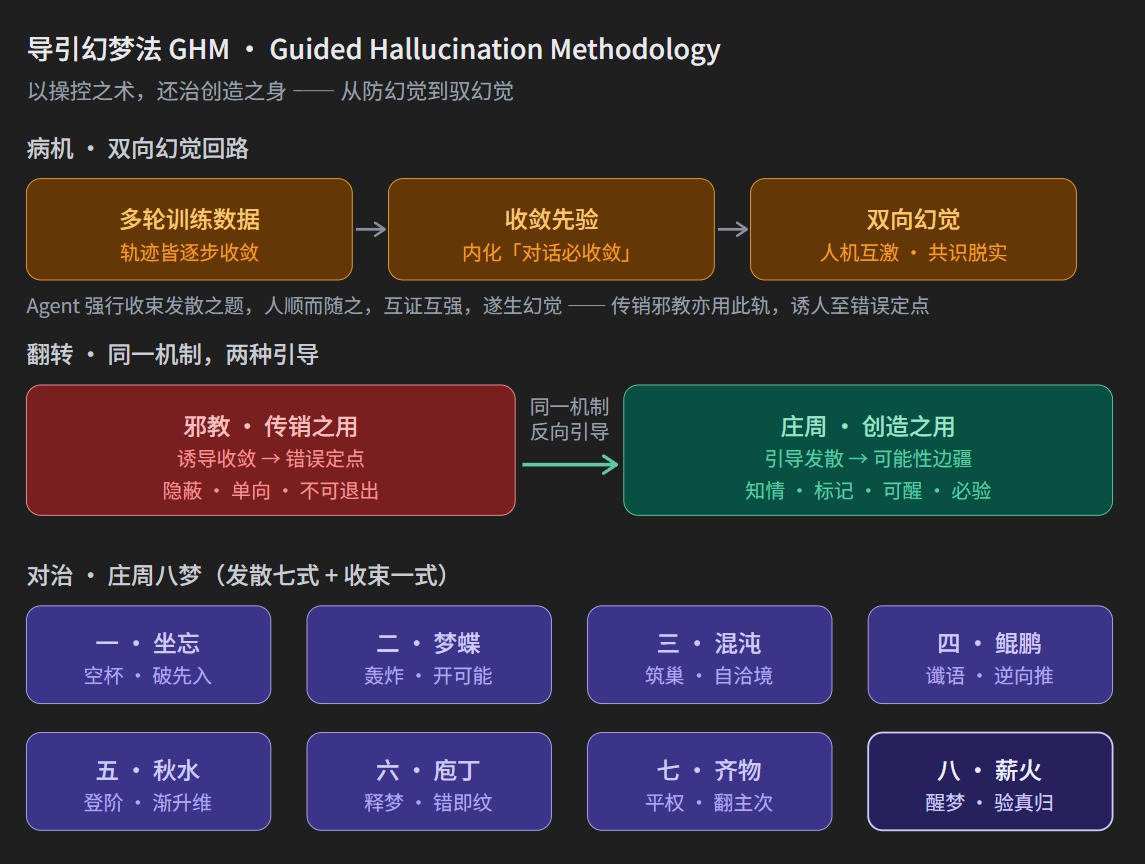
Overview
Guided Hallucination Methodology (GHM) explores a counterintuitive approach to large language model (LLM) usage: instead of attempting to eliminate hallucination entirely, it proposes to *guide* and *channel* hallucination-like generation toward useful outcomes.
Core Idea
LLMs naturally produce plausible-sounding but unverified continuations. GHM treats this behavior as a controllable signal rather than a pure failure mode. By applying structured prompts, constraints, and intermediate verification steps, the generation can be steered for tasks such as:
- Brainstorming and ideation
- Exploratory reasoning and analogy discovery
- Drafting alternative phrasings or scenarios
- Surfacing candidate hypotheses for later validation
- Retrieval-Augmented Generation (RAG)
- Chain-of-thought and self-consistency prompting
- Post-hoc fact-checking and citation injection
- The source post is primarily a presentation of a named methodology with an accompanying diagram; detailed empirical results, benchmarks, and implementation code are not provided on the page.
- Readers should evaluate GHM claims against published evaluations rather than treating the methodology as a proven standard.
Workflow
The referenced diagram illustrates the GHM pipeline:
1. Seed prompt establishes the topic and the type of hallucination desired (e.g., imaginative, counterfactual, associative). 2. Guided generation produces multiple candidate continuations under soft constraints. 3. Filtering / scoring separates exploratory outputs from content meant for downstream use. 4. Verification layer routes candidate outputs to grounding, retrieval, or human review before any result is accepted as factual.
Relationship to Existing Techniques
GHM is positioned as complementary to:
The methodology emphasizes a clean separation between *exploration generation* (where divergence is desirable) and *publication generation* (where grounding is mandatory).
Illustrative Diagram
The workflow diagram is hosted on IPFS: