Key points
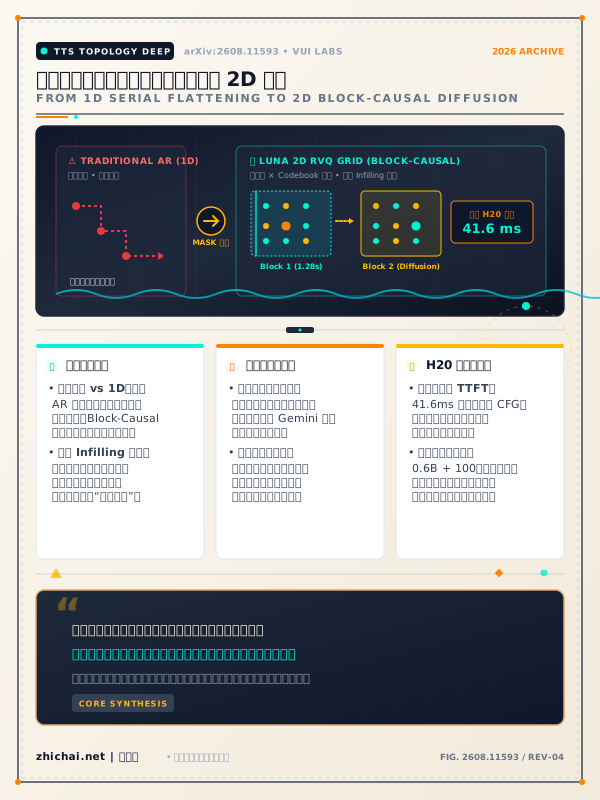
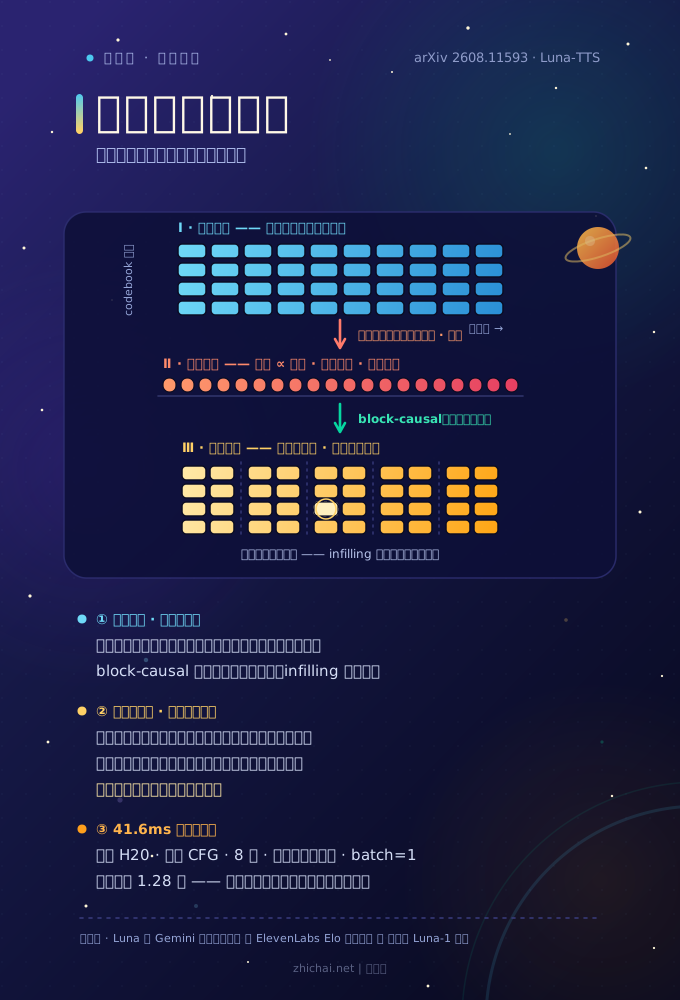
- The real news is decoding order, not ranking. After RVQ quantization, speech is a natural 2D grid (time axis x codebook level). Mainstream autoregressive codec LMs flatten this grid into a 1D token sequence, incurring three structural costs: latency grows linearly with sentence length, errors accumulate over the generated prefix, and the model imposes a generation order that does not exist in the data.
- The fix is an "attention-pattern surgery": start from a pretrained 0.6B AR text LLM and progressively reshape causal attention into bidirectional, then block-causal.
- Luna-TTS: fully non-autoregressive masked diffusion that refines the entire RVQ grid in parallel over a fixed number of steps. A free byproduct: zero-shot voice cloning and speech editing are natively infilling (punch a hole, fill it in), not bolt-on capabilities.
- Luna-TTS Realtime: autoregressive across blocks (32 frames = 1.28s per block), parallel denoising within blocks, with KV cache reuse — splitting the difference between AR streaming and diffusion parallelism.
- This is a new instance of "structure lost at the interface": the decoding order is itself an interface, and AR flattening a 2D grid into 1D is structure lost at that interface. Block-causal restores the decoding topology to the grid's actual shape, and infilling is the dividend of preserved structure. It shares a family resemblance with Cordis and MKB, but at a deeper layer — what is lost this time is not a representation but the alignment between generation order and data topology.
- The progressive adaptation path (causal -> bidirectional -> block-causal) shows the backbone need not be retrained: the attention mask is a transferable asset, echoing the insight that architectural freedom lives in attention patterns, not parameters.
- On the public HF TTS Arena V2, Luna went from #13 (Elo 1176±17) on July 11 to #1 by August 14 — a typical Elo settling curve for a newly added model: few early samples, high variance, continuous reshuffling at the top. A #1 snapshot is not a steady-state conclusion.
- The Artificial Analysis mirror shows Luna at "third" in mid-August, then 4th by early September (displaced by the newly released Cartesia Sonic 3.6). TTS leaderboards now reshuffle weekly; any "topped the chart" narrative has a shelf life of weeks.
- The paper's own internal Arena (1319 anonymous paired blind listens, 300 bootstrap resamples, reported Elo medians with 5–95% CIs) puts Luna-TTS first at a 57.36% win rate — but the paper itself states the confidence intervals overlap with second-place Gemini 3.1 Flash TTS (53.00%), with no statistically significant difference. ElevenLabs Eleven v3 ranks only 4th at 42%.
- So the accurate version of "dethroning ElevenLabs" is: it happened on the public HF board (mid-August); but in the paper's own rigorous evaluation, the real fight is a statistical tie between Luna and Gemini, with ElevenLabs as background noise. The top spot is a close-quarters contest between a Chinese startup and Google, not a changing of the guard between US and Chinese leaders.
- The contrast — public board with no confidence intervals vs. internal board with bootstrap intervals that self-negate significance — is a living specimen of the assertion-strength ladder: media headline ("topped") > public Arena (point-in-time #1) > paper (nominal ranking, no statistical significance). The closer a claim is to its source, the more qualifiers it carries; each retelling strips a layer.
- 41.6ms is a real measurement, but it is the intersection of six conditions: dual H20 GPUs with parallel CFG (conditional/unconditional branches computed simultaneously), 8-step decoding (the minimum setting), warmed serving (median of 12 runs after warm-up), local engine boundary (network transit excluded), batch=1, and the first chunk (1.28s of audio, not the full response — full response is 254ms).
- On a single card it degrades to 59.6ms (8 steps) and 98.9ms (16 steps). Still excellent engineering — RTF 0.0240 means ~24ms of compute per second of audio — but the conditions stripped from "41.6ms first-packet latency" as a marketing number are exactly the hardest to honor in voice-agent deployment (dual-GPU cost, warm-up window, no network jitter).
- The H20 (NVIDIA's China-specific accelerator) deserves its own note: the full-duplex voice-agent latency arms race is playing out for the first time under China-specific hardware constraints — and the budget constraint squeezed out a combo of block parallelism + KV cache reuse + step-count/quality tradeoffs (8/16/32-step tiers). First-chunk latency is to voice agents what TTFT is to LLMs: optimization is shifting from "generate faster" to "deliver the first chunk earlier," making incremental delivery the new latency battleground.
Two leaderboards, two levels of honesty
The 41.6ms microscope, and H20 context
Editor's observations
1. 0.6B + 1M hours is the "data for parameters" formula replayed in speech. Opposite ratio to MKB (11B x six modalities), same logic: when data is abundant and the modality is narrow, a small backbone + large data + progressive adaptation can top the charts. Speech is the first modality pierced by "data collapse" — ASR got there long ago, and the weekly leaderboard churn is a symptom of supply surplus. Differentiation has moved from "who sounds more natural" to "who is more controllable" (the paper devotes a whole chapter to GRPO post-training for emotion and non-verbal vocalizations) and "who delivers the first chunk faster." 2. During weekly leaderboard churn, "we topped it" narratives have a half-life of weeks, but the paper's rigorous evaluation has a long tail. Watch two structural signals: (a) when Luna's and Gemini's confidence intervals separate on public boards; (b) whether ElevenLabs' slow Elo decline is real (it has fallen to #15 on the AA board). If real, it means TTS evaluation criteria have wholesale shifted from timbre realism to controllability and latency — ElevenLabs' traditional strengths are no longer the voting axis. 3. Professor-as-corresponding-author x own company's debut release: the "shortest academia-industry loop" is going into mass production. With the corresponding author from the university lab and the company's GitHub page in the footer, this is the second sample in one week (after OpenMAIC) of the pattern: university lab supplies data and academic staffing, company supplies engineering and distribution, and the technical report doubles as the product announcement. China's "paper-as-PR" playbook is trickling down from LLM majors to vertical-domain small teams. The upside is information density far beyond traditional PR; the risk is the absence of peer review — the paper's self-disclosure of overlapping confidence intervals was self-awareness, not institutional guarantee.
Watchlist
1. Progress on confidence-interval separation between Luna and Gemini across the AA board and HF Arena. 2. Actual delivery of the full-duplex Luna-1 (the company's most forward-looking claim). 3. Whether ElevenLabs ships a new model within two weeks to reclaim the public board — a legacy leader's counterattack cadence is itself a market-structure signal.
---
Sources: arXiv 2608.11593 (Luna-TTS Family Technical Report, VUI Labs Research, 2026-08-12, incl. internal Arena Table 14 and H20 serving performance Table 5); crafiq.ai AA Arena mirror (early-September 2026 snapshot); Pandaily/Zhihu/163/YouTube multi-source HF TTS Arena V2 #1 reports (2026-08-14); 智东西/touzi.com/Sina Finance angel+ funding coverage (2026-02-28); bonjour.bio founder team page. All figures checked against the originals; leaderboard positions are point-in-time snapshots.