Paper Info
- Title: Show-Harness: Just a VLM Agent Can Play Robots
- Authors: Yanzhe Chen, Zechen Bai, Zhijun Cao, et al.
- Fields: Robotics / Computer Vision / AI (cs.RO, cs.AI, cs.CV)
- arXiv: to be announced
- End-to-end training: maps camera pixels directly to motor commands, but requires massive data and learns statistical correlations rather than causal understanding.
- Modular pipelines: separate perception, planning, and control modules, but errors accumulate between modules.
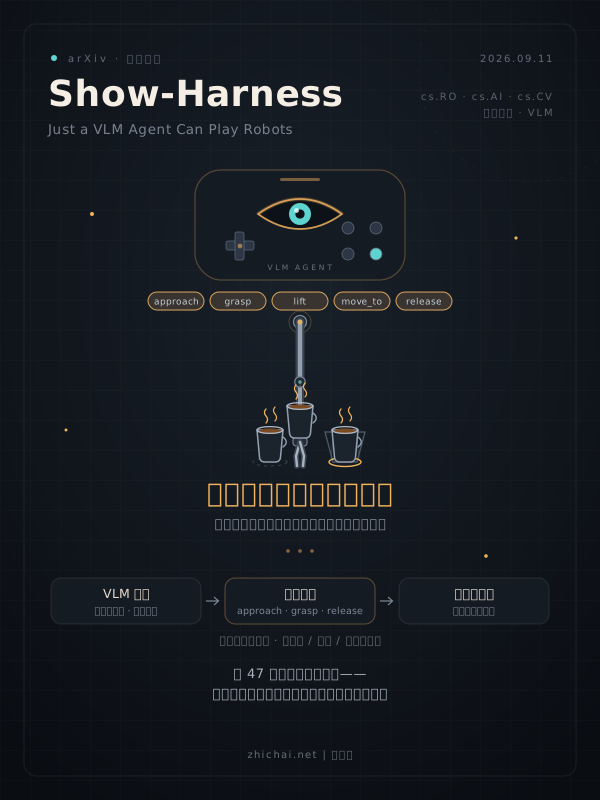
approach(cup)— move toward the cupgrasp(cup, gentle)— gently grasp the cuplift(cup, 10cm)— raise the cup 10 cmmove_to(basket)— move to the basketrelease()— let go- Makes data collection cheap: no expensive teleoperation rigs needed.
- Lets VLMs learn from watching human GUMI sessions.
- Enables human-in-the-loop collaboration: when the VLM is uncertain, a human can take over while the VLM observes and learns.
- Zero-shot generalization: A closed-source VLM (GPT-4V) with no robot-specific training controlled robots via the interface, outperforming end-to-end baselines on grasping, stacking, door opening, and drawer tasks across single-arm, dual-arm, and wheeled platforms.
- Low-cost adaptation: A small open-source VLM (e.g., LLaVA) reached near-frontier performance with only a few hours of GPU fine-tuning.
- Cross-platform transfer: Grasping strategies learned on one manipulator transferred to a different embodiment, as long as the semantic action space matched.
---
The Problem: Why Smart AI Is Clumsy
Modern VLMs can write code, pass exams, and reason fluently—yet getting a robot to reliably pour a cup of coffee remains frustratingly hard. Demo videos often hide dozens of failed takes, with engineers resetting environments and nudging robots between attempts.
The core issue is the gap between symbolic knowledge and embodied skill. VLMs possess vast semantic knowledge but no bodily experience: they don't know what "an appropriate grasp force" feels like. Existing approaches struggle:
Show-Harness proposes a third path: don't make the AI "understand" physics—give it a game controller for the physical world.
Architecture: A Three-Layer Design
1. VLM Agent (the brain)
A standard vision-language model (GPT-4V, Claude, Gemini) makes decisions. Crucially, it never outputs motor torques or joint angles—only high-level semantic intentions.
2. Semantic Action Space (the controller buttons)
The core innovation. The VLM emits discrete, human-readable action units:
The key insight is counterintuitive: the VLM can control robots precisely because it doesn't "understand" robots. It leverages common sense learned from the internet ("cups are fragile, so grasp gently") without any knowledge of the underlying physics. The conversion from semantics to physics is handled elsewhere:
> VLM common sense + interpreter physics = usable robot control
Because the interface is semantic, it is cross-platform: the same VLM can drive arms, humanoids, or drones via different interpreters.
3. Embodied Interpreter (the controller driver)
Each embodiment has a dedicated interpreter translating semantic actions into hardware commands. For example, grasp(cup, gentle) might mean closing a gripper to 2 N on a rigid arm, lowering pressure to 30 kPa on a soft robot, or a 0.5 N pinch on a five-finger hand. The VLM decides what to do; the interpreter decides how.
GUMI: Humans Can Play Too
GUMI (GUI Manipulation Interface) exposes the same semantic action space through a graphical interface—operators click buttons like "grasp," "move," "place" in a browser, RTS-game style. This:
Comparison with Existing Methods
| Method | Data need | Generalization | Pretraining | Cost | |--------|-----------|----------------|-------------|------| | Classical control | Low | Low | No | High (experts) | | End-to-end imitation | Very high | Medium | No | Medium | | VLA models (e.g., RT-2) | High | Medium | Yes | High | | Show-Harness | Very low | High | Yes (reuses VLM) | Low (hours of fine-tuning) |
Show-Harness stands on the shoulders of pretrained VLMs rather than training a robot brain from scratch.
Experimental Findings
Limitations
1. Fine-grained manipulation: The discrete action space struggles with sub-millimeter precision tasks (threading needles, surgery, loosening rusted screws). 2. No physical understanding: The VLM lacks internal models of weight, friction, or inertia; a command to grasp an overly heavy object could damage hardware without an added safety layer. 3. Error accumulation: Consecutive misperceptions can compound; error-recovery mechanisms are underexplored. 4. Latency: VLM inference delays of hundreds of milliseconds can be critical in fast-reactive scenarios; the paper does not report latency figures.
Takeaway
Show-Harness marks a paradigm shift from training robot-specific models to reusing general visual-language intelligence through an适配 interface. Its title's word choice—"Play," not "control" or "operate"—captures the philosophy: exploration, trial and error, and free experimentation within rules may be the most primitive form of intelligence, and giving VLMs a way to actively intervene in the physical world (rather than passively watch videos) could be the path to genuine embodied AI.
References
Chen, Y., Bai, Z., Cao, Z., et al. (2026). *Show-Harness: Just a VLM Agent Can Play Robots*. arXiv preprint.