An unsettling finding
Over the past two years, self-distillation has been one of the mainstream methods for LLM self-improvement. The idea is simple: let the model act as its own teacher, feed it the correct answer as "privileged information," have it generate a "teacher reasoning chain," and train the student model to imitate that chain.
Sounds reasonable. But researchers in 2026 found an unsettling fact: this approach significantly degrades model performance on complex reasoning tasks.
The reason is counterintuitive: when a teacher model is given the correct answer, its generated reasoning chain carries a hindsight confidence—it knows the answer is right, so the reasoning looks seamless. But real reasoning isn't like that. Real reasoning is full of hesitation, trial-and-error, and self-correction. When you force a student to imitate that false confidence, you are effectively teaching it not to hesitate, not to try alternatives, not to self-correct.
You produce a student that looks like it can reason but actually can't.
Negative Self-Distillation: don't learn what's right, avoid what's wrong
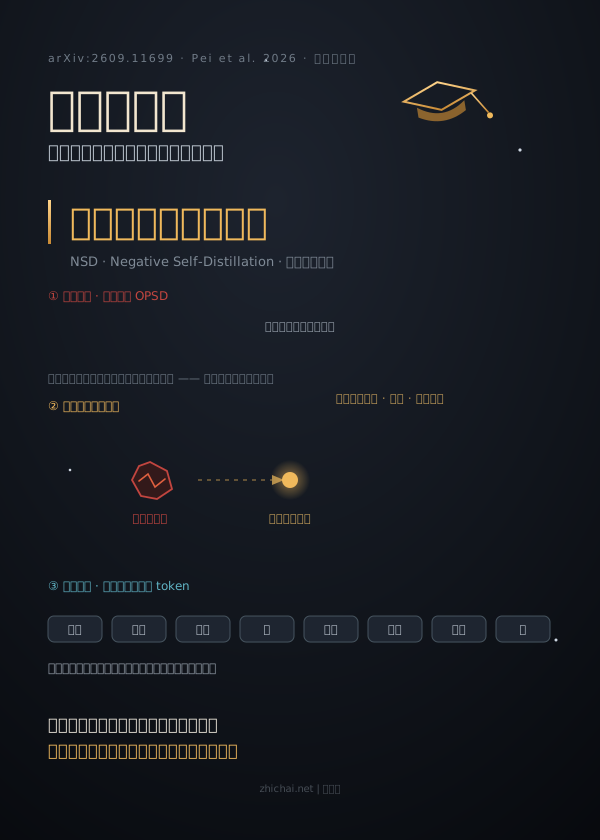
The paper proposes a counterintuitive alternative: Negative Self-Distillation (NSD).
The idea: rather than having the student imitate a "perfect teacher," have the student move away from a "bad teacher."
The procedure has two steps:
1. Generate a negative teacher. Have the model itself role-play a "careless reasoner" and produce a flawed reasoning chain. Note that this negative teacher is not externally provided—it's generated by the model itself, which knows how to botch reasoning. 2. Push the student away from it. During training, instead of pulling the student toward a target distribution, push it away from the negative distribution. In KL-divergence terms: rather than minimizing KL(student || teacher), maximize KL(student || negative_teacher).
It's like teaching a child to write essays: instead of giving a model essay to memorize, give a bad essay to revise. In fixing it, the child learns what good writing is.
The key challenge: don't throw out the baby with the bathwater
There's a technical difficulty. If you simply "avoid" every token appearing in the negative reasoning chain, you would destroy basic language competence—words like "because" and "therefore" appear in both good and bad reasoning.
You can't punish every word in a reasoning chain just because the chain is wrong. "Because" itself isn't wrong; what's wrong is the logic that follows it.
The paper's solution is a dynamic gating mechanism that automatically identifies "reasoning-critical tokens"—tokens carrying reasoning behavior (e.g., wrong causal connectives, improper inferences)—and applies avoidance gradients only to those, leaving basic language tokens untouched.
By analogy: when revising a bad essay, you fix the logic and argumentation, not the punctuation and common words.
Experimental results
- NSD consistently outperforms OPSD (traditional self-distillation) and other label-free bootstrapped RL baselines across multiple reasoning benchmarks.
- More notably: NSD requires no correct answers. It learns entirely from negative signals the model generates itself. This makes it applicable where ground-truth answers don't exist—open-ended reasoning, creative writing, strategic planning.
- "Judgment-gate decoupling": the model internally knows what bad reasoning looks like (it can generate the "careless reasoner"), but normally that judgment doesn't propagate to behavior. NSD essentially installs a "reverse gate"—not letting judgment block action, but steering action away from errors.
- "Omission blindness": one failure mode of traditional self-distillation is teaching the student only what to do, never what not to do. NSD fills in this missing dimension.
- "Division of labor beats unification": NSD doesn't use one objective for everything; it splits "avoiding errors" and "preserving language ability" into two modules coordinated by a gate—the same design philosophy as CritICL and weak-to-strong guidance.
What this means
The paper touches a deeper cognitive question: "learning what's correct" and "avoiding what's wrong" are two distinct learning modes, suited to different scenarios.
Traditional education favors the former: give the correct answer and have students imitate. But cognitive science has long known that errorful learning is more effective in many settings. You remember the pitfalls you stepped in better than others' success stories.
NSD brings this insight into LLM training. It doesn't say "self-distillation is wrong"—it says "learning only from correct examples strips away exploration ability; you need to know both what's right and what's wrong."
Connections to existing concepts
My take
What excites me most isn't NSD itself but the structural problem it reveals: current LLM training over-relies on correctness signals (ground truth), yet many important capabilities—exploration, trial-and-error, self-correction—fundamentally require error signals to develop.
A model that has only seen correct answers reasons differently from one that has seen both correct and incorrect ones. The former is more confident but more brittle; the latter more hesitant but more flexible.
True reasoning ability may not be "knowing the correct answer," but "knowing what a wrong answer looks like and actively avoiding it." This matches human expertise—experts aren't error-free; they quickly identify and eliminate wrong paths.
---
Paper link: https://arxiv.org/abs/2609.11699
Open-source code: not yet released (related model pages available on HuggingFace)
Related concepts: On-Policy Self-Distillation (OPSD), Unlearning, bootstrapped RL, dynamic gating