Overview
Field: ML Authors: Reina Mun, Zishen Wan, Vijay Janapa Reddi Published: 2026-09-15 arXiv: 2609.12322
Abstract (original)
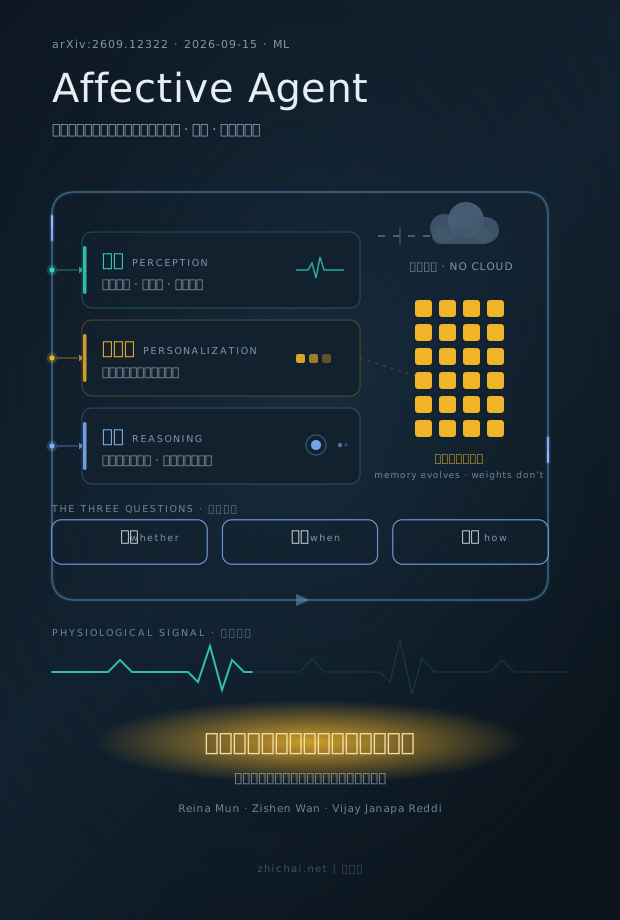
Affective computing has advanced wearable state inference, but on-device reasoning about whether, when, and how to intervene remains challenging. We present Affective Agent, a three-layer reference architecture for personalized intervention reasoning under uncertainty on wearable-class hardware. It combines a compact sub-billion-parameter language model with physiological evidence, context, and user history to decide whether, when, and how to intervene, without cloud dependency or per-user retraining. The architecture is organized into three interacting layers (perception, personalization, and reasoning), adapting to individual users through host-managed structured memory evolution rather than per-user weight updates. We instantiate Affective Agent in indoor environmental quality control and evaluate on held-out, simulator-generated longitudinal scenarios spanning physiological variation, context, signal quality, and intervention history. Results show that, in this synthetic evaluation, memory-driven personalization and two-pass structured reasoning improve intervention decisions. By moving the decision layer on-device, this work demonstrates a path from wearable state inference toward closed-loop personalized intervention on wearable-class hardware.
Key points
- Problem: Wearables can infer user states, but deciding on-device *whether, when, and how* to intervene—under uncertainty—is still an open challenge.
- Approach: A three-layer architecture (perception, personalization, reasoning) built around a compact sub-billion-parameter language model that fuses physiological evidence, context, and user history.
- Personalization: Achieved via host-managed structured memory evolution instead of per-user retraining or weight updates; fully on-device, no cloud dependency.
- Evaluation: Instantiated for indoor environmental quality control; tested on held-out, simulator-generated longitudinal scenarios varying physiology, context, signal quality, and intervention history.
- Findings: In this synthetic evaluation, memory-driven personalization and two-pass structured reasoning improved intervention decisions.
- Significance: A step from passive wearable state inference toward closed-loop, personalized intervention on wearable-class hardware.
*Auto-collected on 2026-09-15.*